

Judge Robes for Woman: How to Choose the Right Fit
Your first sitting is approaching, and you're comparing robes that look almost identical on screen. One promises a fitted silhouette, another looks cooler, and neither photograph tells you whether the sleeves will clear your papers or the hem will catch when you step onto the bench.
If your search for judge robes for woman has brought you mostly product pictures, start somewhere less glamorous: your court's written dress rule. Then work through fit, fabric and delivery. Decoration comes last.
Table of Contents
- Check Your Court's Robe Rules Before You Buy
- Judge Robe Styles for Women at a Glance
- How to Measure for a Robe That Fits
- Fabric, Lining and Layering for Long Court Days
- Buyer Scenarios and the Robe Each Needs
- Pick Your Robe by Budget and Deadline
- Order Your Judge Robe Step by Step
Check Your Court's Robe Rules Before You Buy
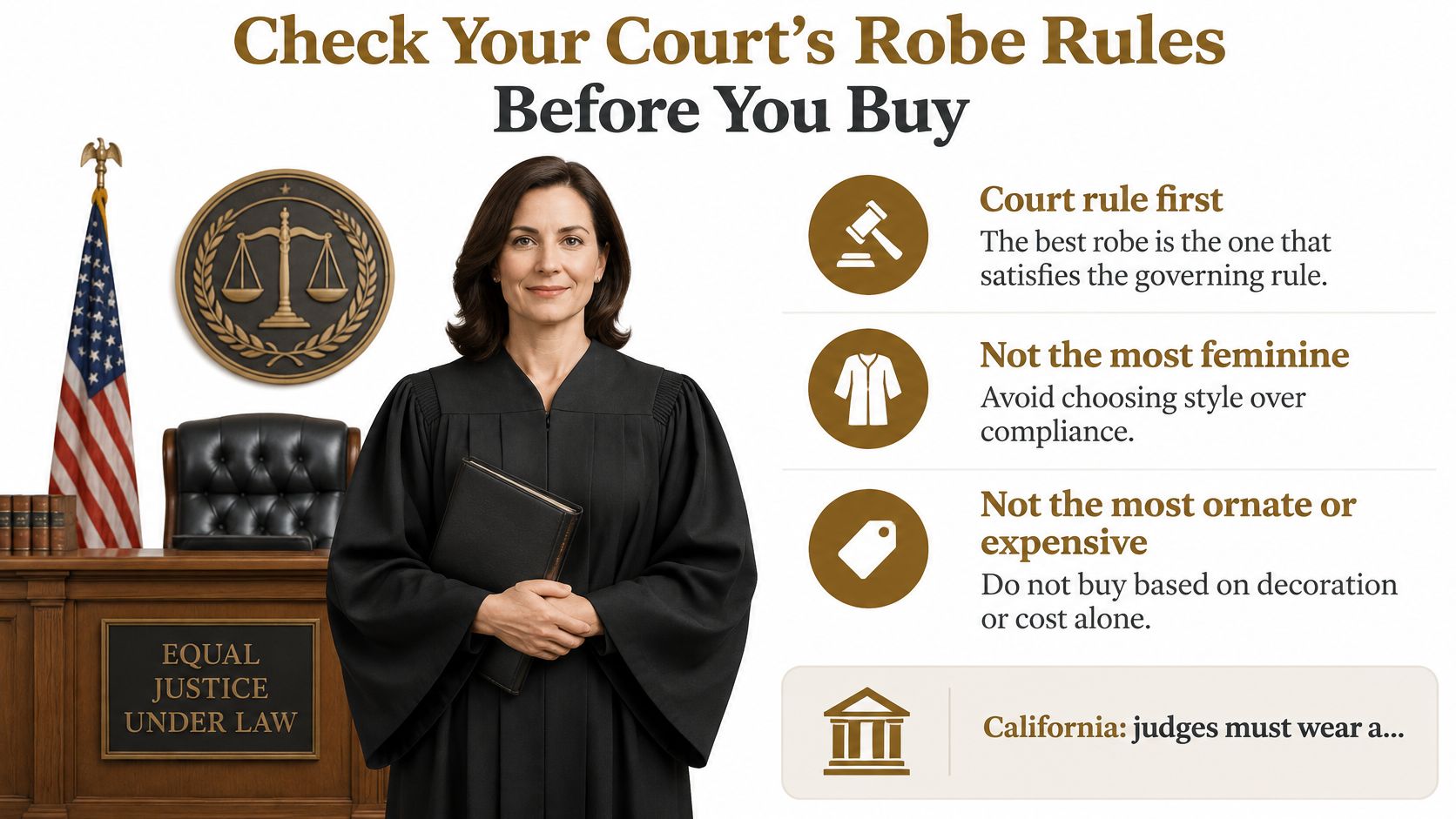
The best robe is the one that satisfies the governing rule, not the most feminine, ornate or expensive option. A flattering garment is still the wrong purchase if its length, sleeves or detailing don't meet your court's requirements.
California provides a useful example: the California Judges Association's education resources describe the requirement for judges to wear a judicial robe in open court that is black, extends below the knees and has sleeves reaching the wrists; the rule doesn't prescribe the material. That leaves room to choose fabric for comfort, but not to substitute a shorter fashion-inspired garment.
Use this checklist before comparing construction details.
Verify the requirement in order
- Identify the court. Establish the court level and whether federal, state or another jurisdiction's requirements govern your sitting.
- Find the written authority. Obtain the dress rule and any applicable local court order. A colleague's recollection is useful context, not a substitute.
- Confirm the physical requirements. Record the permitted color, required length and sleeve coverage. Resolve ambiguous wording with the court administrator in writing.
- Separate ordinary and ceremonial sittings. Don't assume that attire accepted at an investiture is appropriate for a routine calendar.
- Check approved purchasing arrangements. Ask whether the court uses an approved pattern or supplier, especially if an administrator will authorize reimbursement.
- Choose construction afterward. Once the boundaries are clear, select fabric, lining and closures for the room and your workload.
Federal and state expectations can differ, and local courts may follow more traditional norms than a broad dress rule suggests. An accessory that appears in another judge's portrait isn't automatically approved for your courtroom.
Buying rule: Treat compliance and comfort as separate checks. Passing one doesn't establish the other.
A robe can meet the written specification yet pull over your jacket or bunch when you sit. Equally, a comfortable robe can fail the court's sleeve requirement. Keep the governing rule, any written clarification and the order confirmation together so you can explain exactly what you purchased and why.
Judge Robe Styles for Women at a Glance
Two robes in the same marked size can hang very differently on the bench. A full, pleated pattern carries volume through the body and sleeves; a closer coat-cut pattern concentrates structure at the shoulders. Ordering by clothing size alone is how a judge ends up with a robe that pulls across the jacket or pools at the hem.
Pick the general shape first, then decide whether you are shopping an in-stock listing or commissioning a custom garment. The order matters: the category tells you what the robe is for, and the listing type tells you how far it can be adjusted to you.
Judge robe style categories for women
| Robe Category | Defining Feature | Best Fit |
|---|---|---|
| Traditional full-sleeve robe | Pleated front and back, full sleeves | Standard courtroom sittings |
| Lightweight robe | Breathable fabric for all-day wear | Long calendars and warm or variable courtrooms |
| Coat-style custom robe | Coat-cut sleeves, fluted shoulders | Judges who want a sharper, more structured silhouette |
| Ornamented custom robe | Shoulder braids, decorative fluting, pocket slits | Senior or ceremonial roles where the court allows decoration |
| Embroidered custom robe | Personalized embroidered initials | Judges who want a personal identifier on the robe |
These categories overlap. Lightweight describes fabric, embroidered describes a finishing detail, and neither tells you the sleeve shape or body cut. Read every listing for both construction and finish.
In-stock suits a judge whose measurements sit inside the size chart and who needs a straightforward purchase. Custom earns its longer timeline when height, arm length or the desired silhouette goes beyond standard sizing; a made-to-order robe can take 12 to 15 business days to produce, so the deadline shapes the decision as much as the fit does. Neither label guarantees compliance with the written rule or a successful fit.
Adaptation without abandoning formality
Women judges have adjusted the established uniform, keeping its full form and adding collars or jabots where the neckline assumed a man's shirt and tie. The Supreme Court's historical exhibition describes how Sandra Day O'Connor and Ruth Bader Ginsburg used those additions to preserve judicial formality.
That history explains much of the significance of female judge robes without creating any requirement to accessorize. A plain neckline is just as deliberate a choice.
Shortlist a category and a listing type before weighing decorative details. Candidates meant to solve the same practical problem are far easier to compare.
How to Measure for a Robe That Fits
A robe cut from a men's pattern puts the shoulder seam and dart positions in the wrong place on many women. Shoulder breadth, bust projection, arm length and how the fabric sits over your hips all vary independently of height, so a single unisex size rarely solves fit on its own.
A University of Washington law review article challenges courtroom-attire guidance that assumes the same approach works equally well for women with different body dimensions and professional contexts. For buying purposes, a standard men's pattern won't reliably deliver equivalent proportions.
Take measurements over the intended clothing
Use a flexible dressmaker's tape and have someone assist. Stand naturally rather than lifting your chest or drawing in your waist, and record the units alongside every measurement.
- Dress for the fitting. Wear the blouse, jacket or dress you expect to use underneath, and empty bulky pockets.
- Stand straight without shoes. Note your usual courtroom footwear separately so the maker can account for heel height when setting the hem.
- Keep the tape level and snug. Pass it around the fullest point and keep it flat across the back without compressing the clothing.
- Measure the body, not the waistband. Follow the natural waist and the fullest part of the hips rather than a trouser line.
- Bend the arm slightly. A sleeve measurement taken on a straight arm runs short once you reach forward.
- Label vertical measurements by their starting point. A nape-to-floor measurement begins at the base of the neck; a shoulder-to-floor measurement begins at the shoulder. Follow the order form rather than treating the two as interchangeable.
- Stop at the shoulder points. Measure across the back between the shoulder points without extending the tape down the upper arms.
Judicial Attire's measuring guidelines should govern the measurements submitted with an order. For a supplementary explanation of everyday clothing measurements, Cashmere Boutique's cashmere clothing size guide can help with general terminology, while robe-specific instructions take precedence for this purchase.
Measurements to record for a judge robe
| Measurement | What It Controls | Fit Problem If Wrong |
|---|---|---|
| Height | Overall robe length | Hem sits too high or drags on steps |
| Bust or chest | Body width and front closure | Pulling across the torso |
| Waist | Fitted shape through the middle | Gaping or bunching at the sides |
| Hip | Room around the lower body when seated | Hem tightens or rides up when seated |
| Sleeve length | Sleeve reach to the wrist | Sleeves shorten or interfere when reaching |
| Shoulder-to-floor | Full hem length | Hem contacts seating or steps |
| Shoulder width | Mobility across the back | Restricted movement when reading or reaching |
Submit actual body measurements and let the maker add ease. Your recorded numbers describe your body; the finished garment dimensions remain the maker's calculation.
Before accepting the robe, sit, read, reach toward a document and turn in your chair. Look for closure strain, sleeve interference and fabric trapped under the seat. Store the accepted measurements with the finished order details for replacements.
Fabric, Lining and Layering for Long Court Days
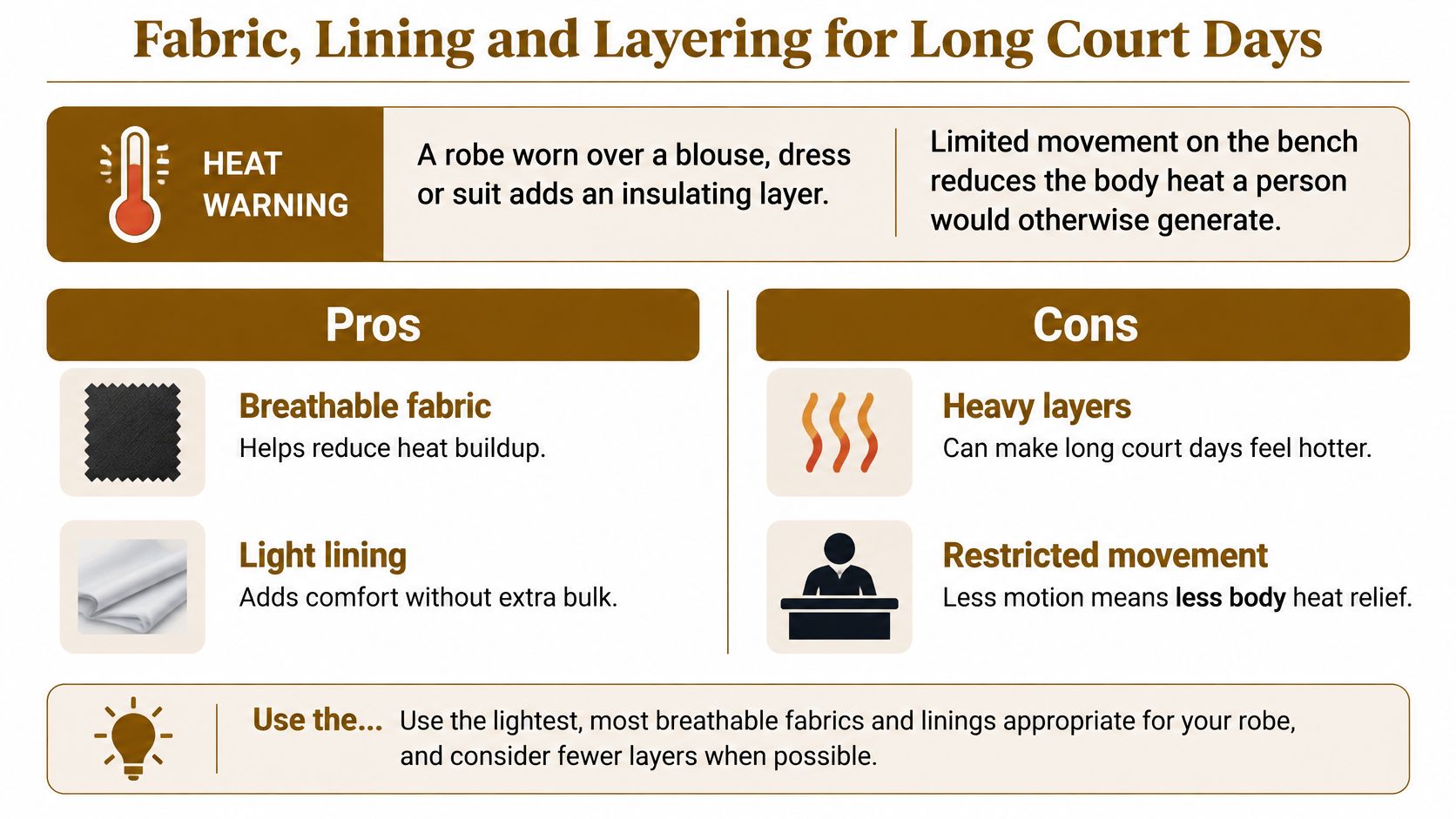
A robe worn over a blouse, dress or suit adds an insulating layer. Limited movement on the bench reduces the body heat you'd generate while walking, so the same robe can feel warm during a hurried arrival and chilly during a quiet hearing.
A controlled jacket study published in The Journal of the Textile Institute found that female participants cooled more easily during rest and were more sensitive to humidity. This wasn't a judicial-robe test, so use it to understand the clothing microclimate, not to predict how a particular robe will perform.
Use the seated test to judge the complete clothing system, not the outer fabric alone.
Specify comfort rather than fabric weight alone
- Breathable outer fabric. A relatively lightweight material is a useful starting point, but check opacity and drape against a light background.
- Smooth, low-bulk lining. Lining should slide over clothing without catching at the elbows or gathering behind the waist. More lining isn't automatically more comfortable.
- Room for layers. Your jacket sleeves and blouse cuffs shouldn't be compressed by the robe's armholes or lining.
A matte finish controls shine; crease resistance helps the robe remain presentable after sitting. Neither feature establishes breathability. A heavier lined option may suit a consistently cold room but can become uncomfortable during travel between chambers and a warmer courtroom.
Removable underlayers are more adaptable than buying an excessively heavy outer garment. Choose them alongside your clothing worn under judicial robes, including cuffs, collars and jacket shoulders.
Don't solve a cold-room problem by committing yourself to a robe you can't tolerate elsewhere.
Nuage Wears' sleepwear advice for cooler, comfier nights offers a separate context for thinking about personal temperature preferences, not a courtroom fabric specification.
Test your candidate while seated, reading and reaching, then walk between rooms. Notice cling, trapped warmth and lining drag before removing tags or authorizing alterations.
Buyer Scenarios and the Robe Each Needs
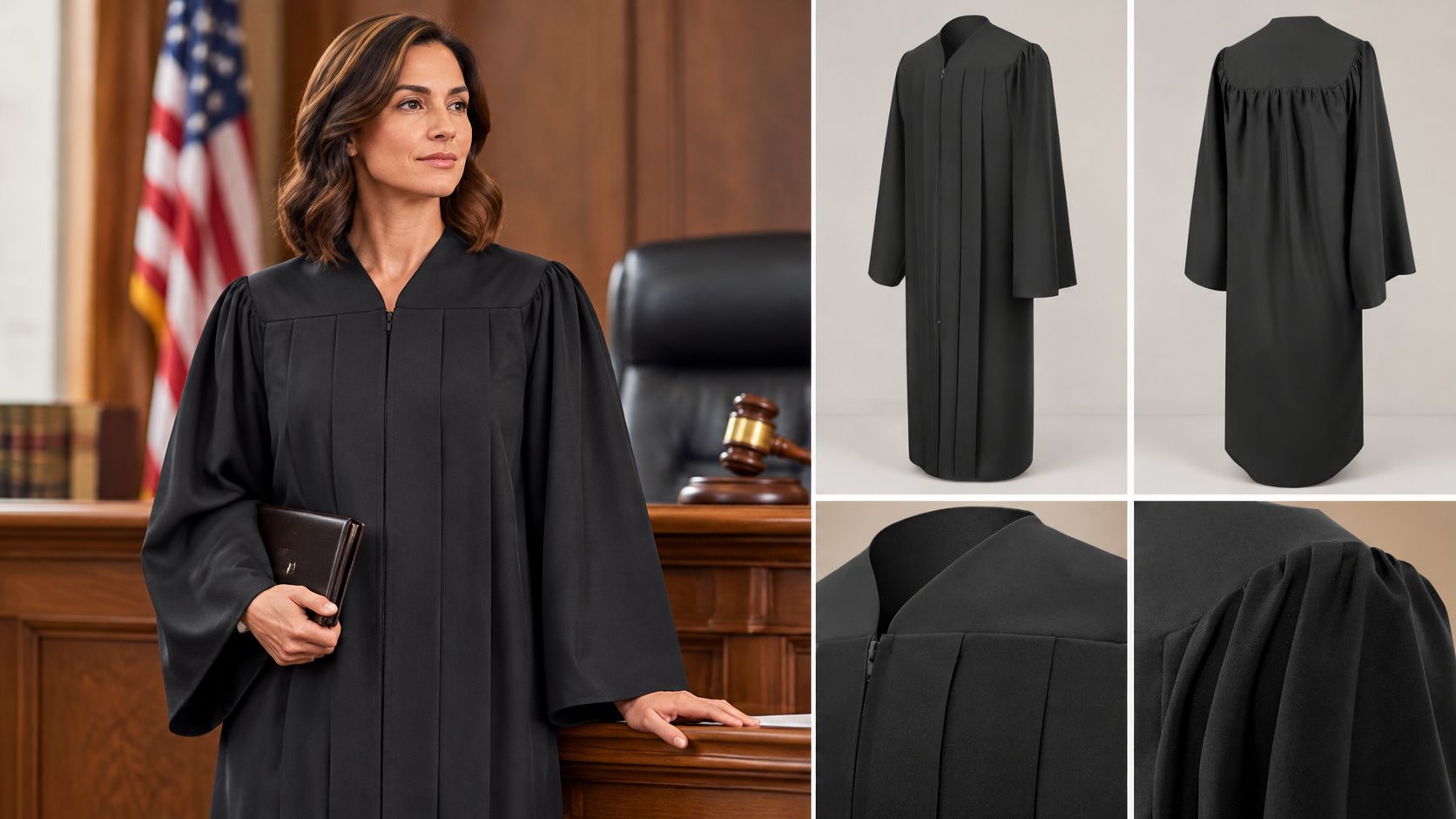
A robe suitable for a ceremonial photograph may be a poor choice for a judge moving repeatedly between hearings and chambers. Start with the wearer's actual assignment rather than treating women judges as a single fit category.
The UNDP Women in the Judiciary technical note identifies persistent differences between women's representation in lower courts and senior judicial leadership. An order for women judges therefore spans new appointees and senior officeholders alike. A women's label says nothing useful about cut on its own; the specification should follow each wearer's role and recorded measurements.
A cold courtroom and a long calendar
A newly appointed judge works in a heavily air-conditioned room. She needs a robe that moves smoothly over her blouse and leaves space for a removable underlayer, rather than a bulky garment that becomes uncomfortable on the walk back to chambers.
She should test the combination at the desk as well as standing. Fabric that feels pleasant against the hand may still catch on a jacket, and a fit that works upright can pull across the shoulders once she sits down to read.
Ceremonial responsibilities
A presiding judge expects to conduct formal sittings. She obtains the ceremonial dress requirement before considering ornamentation, then checks whether embroidered identifiers should be visible or concealed.
Seniority alone doesn't justify extra decoration. Where the rules permit it, ornament can serve the occasion, while the fit underneath still has to carry her through a full day of sitting, standing and reading at the bench.
An institutional order
A court administrator buying for ten judges works most efficiently from a wearer-by-wearer record: private measurements, approved specifications and an individual acceptance check for each robe.
Ordering the same nominal size from a shared pattern may simplify paperwork but create alteration work. Keep each judge's fit approval separate from the administrator's approval of the general style.
A changing body or mobility need
A judge anticipating pregnancy, postpartum changes or altered mobility should raise adjustment options before construction starts. The practical questions are specific: closure access, shoulder movement, sleeve clearance, and whether the garment can be altered later without remaking it.
Cultural layering belongs in that same conversation. Record the clothing the robe must accommodate; the wearer should not have to justify her presentation choices.
Authority comes from the office and the work. The robe should support both without drawing attention to itself or restricting the wearer.
Pick Your Robe by Budget and Deadline
Listed sale prices by robe and listing type
| Robe | Listing Type | Current Sale Price |
|---|---|---|
| Lightweight Judge Robe | In-stock | $39.95 |
| Principal Judge Robe | In-stock | $79.95 |
| Premium Judge Robe | Custom | $109.95 |
| Pontiff Judge Robe | Custom | $129.95 |
| Plymouth Judge Robe | Custom | $129.95 |
| Magisterial Judge Robe | Custom | $299.95 |
| Juristic Judge Robe | Custom | $349.95 |
These are the listed sale prices; confirm them before ordering because prices can change. Use the table to build a shortlist. Price alone will not tell you how a robe is built: the Pontiff and the Plymouth both sit at $129.95, and no price column can explain what separates them.
Spend on the constraint you actually have
An in-stock robe is the economical choice when its dimensions match your recorded measurements. A lower purchase price stops being useful once substantial sleeve, shoulder or hem alterations enter the bill. If the choice is between altering a cheap robe into shape and paying for a custom pattern, I would pay for the pattern.
Custom tailoring earns its keep when standard proportions do not work. It can also be justified when a specific silhouette matters, but be precise about what you want changed: a neater sleeve is a clearer instruction than a more feminine fit.
Cost differences reflect the listing type, individual tailoring, lining, finishing work and decoration. Ask which features are included rather than assuming the highest-priced option is the most suitable for daily court.
- Spend first on fit. Restricted shoulders and an unstable hem affect the working day more than decorative finishing.
- Pay for decoration deliberately. Braids, fluting or initials should serve an approved purpose, not compensate for an unsuitable pattern.
- Budget for care and transport. A garment bag is a separate accessory, so decide whether you need one rather than assuming it comes with the robe.
Names such as Pontiff, Plymouth and Juristic do not establish a garment's category on their own, and a price table cannot resolve that question. Match the listed name to the style category you selected before paying.
Work backward from the first sitting
Custom production and delivery are separate stages. The Juristic Judge Robe takes 12-15 business days to make; that is production time, not a promise that the garment will reach you within the same window.
Write down the date you need the robe in hand, then subtract time for delivery, inspection and any agreed correction. For a ceremony, plan against the fitting deadline rather than the ceremony date itself. That buffer is where most late orders go wrong.
Orders can be placed online, by email or by telephone. Confirm destination-specific delivery arrangements before committing, and do not assume a faster shipping service will shorten production.
Deadline safeguard: Get the expected dispatch timing and your required arrival date recorded separately.
Choose the robe that passes the governing rule, fits your measured body and reaches you within both your budget and your usable deadline.
Order Your Judge Robe Step by Step
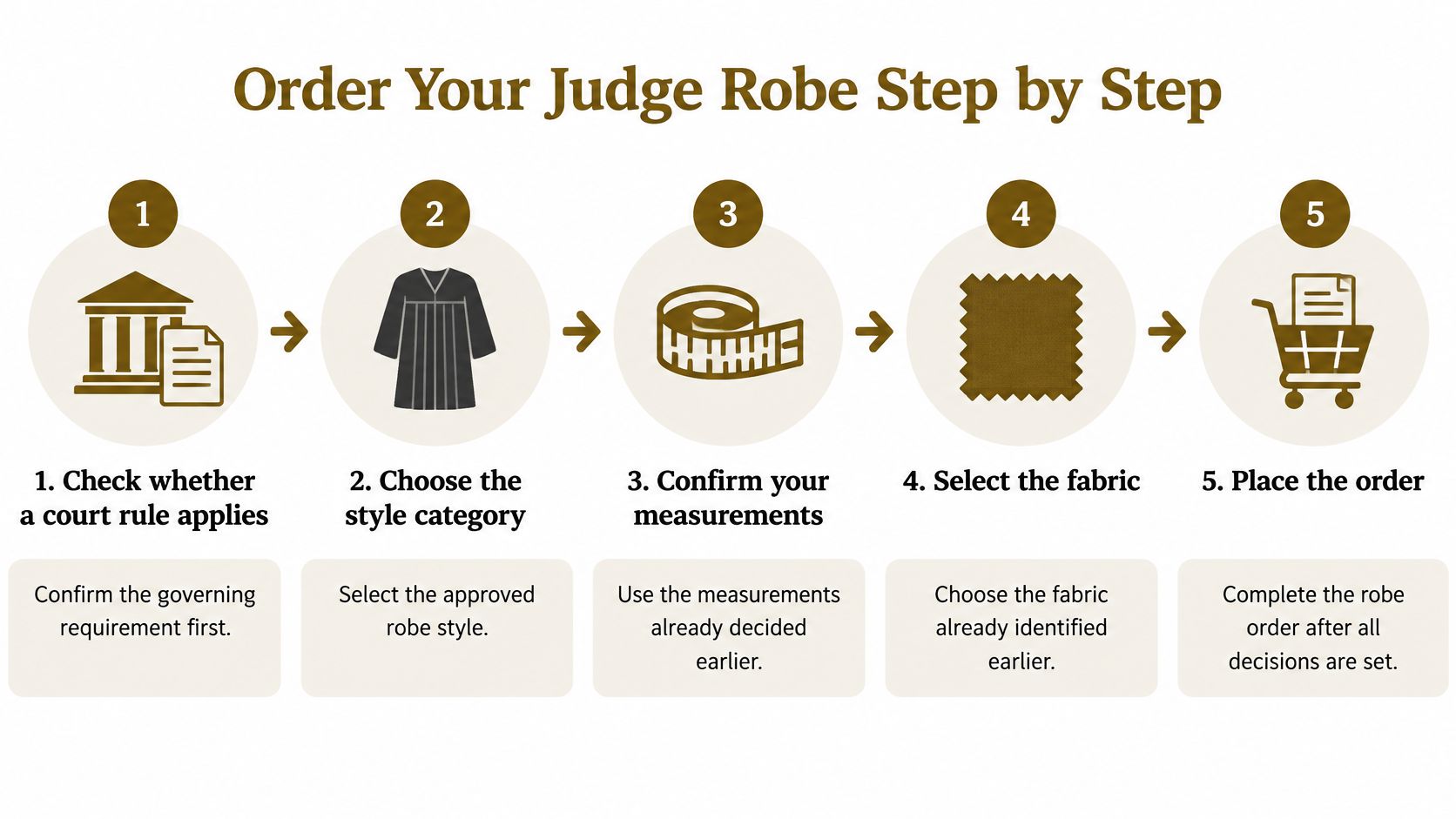
With the court requirement, style, measurements and fabric decided, the remaining job is to create an accurate written order. Don't rely on a product photograph to communicate the details.
Keep the sequence visible while completing your purchase.
Complete and preserve the order record
- Match the listing to your measurements. Select an in-stock size only if its dimensions work; otherwise use a custom listing. The common mistake is accepting the wrong sleeve or hem length to save on the initial price.
- Confirm terms in writing. Ask us for production timing, rush options, alteration arrangements and return terms applicable to your order. Don't assume a custom garment has the same return conditions as an in-stock purchase.
- Decide on storage. Add a garment bag if you need protection during transport or between sittings. Don't leave storage until the robe arrives.
- Submit through your preferred channel. Order online, by email or by telephone, then confirm the listed name, style, measurements and deadline in writing before production starts. A verbal discussion alone won't show which measurements were used.
- Retain the complete record. Save the measurement sheet, specification and confirmation together. Losing them makes a replacement order harder than it needs to be.
If the delivered robe doesn't fit, contact us promptly within the applicable return window. Send the submitted measurements and clear photographs of the problem area, then request an alteration or exchange under the order's terms before wearing it in court.
Judicial Attire offers in-stock and customizable judicial robes for women and men, along with measurement guidance and garment bags. Visit Judicial Attire with your court's written requirements, recorded measurements and required delivery date to narrow your choice before ordering.