

Judical Robes: Styles, Sizing and How to Order
You're ordering a robe for a new appointment, replacing one that no longer fits, or sourcing several for a court. The catalog looks straightforward until you have to choose a length, interpret “custom,” and decide whether decorative details are appropriate for the bench.
The safest starting point isn't fabric or price. It's the court's requirements. If you're searching for judical robes, narrow the choice by jurisdiction and proceeding first, then compare construction, measurements, and the total cost of getting a usable garment.
Table of Contents
- Check Local Rules Before You Choose a Robe
- Robe Styles, Stock Status and Prices
- How to Get Measured for a Custom Robe
- Customizing Without Losing the Uniform Look
- Wearability Needs Beyond Standard Sizing
- Choose Your Robe and Place the Order
Check Local Rules Before You Choose a Robe
A black robe isn't automatically suitable for every courtroom. Similar-looking garments can reflect different rules, traditions, and expectations, so a robe that works for a colleague elsewhere may not be right for your appointment.
The Smithsonian's account of American judicial dress explains that the U.S. federal judiciary has no single national robe design. Local practice matters, while other jurisdictions may use business suits for ordinary proceedings or reserve elaborate robes for ceremonies. Visual uniformity doesn't mean legal uniformity.
A written rule can be much more specific. California Rule of Court 10.505 requires black robes extending in front and back from the collar and shoulders to below the knees, with sleeves reaching the wrists, and conformity with the style customarily worn in U.S. courts. An unconventional garment can therefore be unsuitable even when its fabric and tailoring are good.
Establish what applies to your seat
Separate mandatory requirements from habits that colleagues follow. Also distinguish everyday courtroom dress from ceremonial attire, and check whether trial and appellate assignments follow the same practice.
Before ordering, confirm:
- The assignment: Is a robe required for this seat and this kind of proceeding?
- The approved appearance: What color, silhouette, collar, and sleeve treatment does the court expect?
- Permitted accessories: Are contrasting collars, head coverings, trim, or visible initials acceptable?
- The decision-maker: Can the clerk, chief judge, or court administration confirm the answer in writing?
A photograph is useful for understanding the expected look, but it isn't a substitute for the applicable rule. Ask for both when the written requirement leaves construction details open.
Robe requirements by jurisdiction type
| Case | What the rule or practice says | Who to ask |
|---|---|---|
| California state courts | Rule 10.505 sets black color and requires conformity with the style customarily worn in U.S. courts | Court administration |
| U.S. federal courts | No single national robe design; tradition and local court practice set the look | Chief judge or clerk |
| Courts that use business suits | Robes aren't required for regular proceedings where suits are the prescribed attire | Court administration |
| Ceremonial occasions | Ornate robes may be reserved for ceremonial dress rather than regular hearings | Court administration |
| Other jurisdictions | Local requirements govern; colors or accessories may identify a court or proceeding | Clerk or court administration responsible for judicial dress |
Use the relevant case in the table to identify who should approve the purchase before you commit to a model.
Robe Styles, Stock Status and Prices
Once local rules establish the acceptable robe style, compare the available models by stock status, construction, and price. In-stock robes use existing inventory; custom robes offer a made-to-order option and can be adjusted to the wearer's measurements.
| Robe style | Stock status | Key construction features | Current sale price | Best suited to |
|---|---|---|---|---|
| Lightweight Judge Robe - In-Stock Judicial Robe | In-stock | Traditional full sleeves; pressed pleats front and back; reinforced stitching throughout; breathable fabric | $39.95 | Wearers seeking a lightweight robe designed for courtroom comfort |
| Principal Judge Robe | In-stock | Traditional full sleeves; pressed pleats front and back | $79.95 | A traditional pleated style available in stock |
| Premium Judge Robe | Custom | Reinforced stitching on the yoke and shoulders; gathered sleeves with a wide elastic band at the wrist | $109.95 | Buyers seeking reinforced construction and a custom fit |
| Plymouth Judge Robe | Custom | Black robe made for women and men | $129.95 | Buyers seeking a black custom robe in a classic style |
| Pontiff Judge Robe | Custom | Custom judicial robe | $129.95 | Buyers considering a custom robe |
| Magisterial Judge Robe | Custom | Custom judicial robe | $299.95 | Buyers considering a custom robe |
| Juristic Judge Robe | Custom | Decorative shoulder braids; fully lined sleeves with hidden cuffs and buttons; pocket slits; personalized embroidered initials; hand-detailed fluting; classic draped yoke with a darted yoke portion; premium matte dull-finished fabric | $349.95 | Buyers seeking a more decorative custom style, where local rules permit |
| Judicial Robe Garment Bag | Accessory | Garment bag for a judicial robe | $19.95 | Storing or transporting a robe |
These are listed prices. Check the selected robe and options at ordering, and confirm whether the garment bag is included or purchased separately.
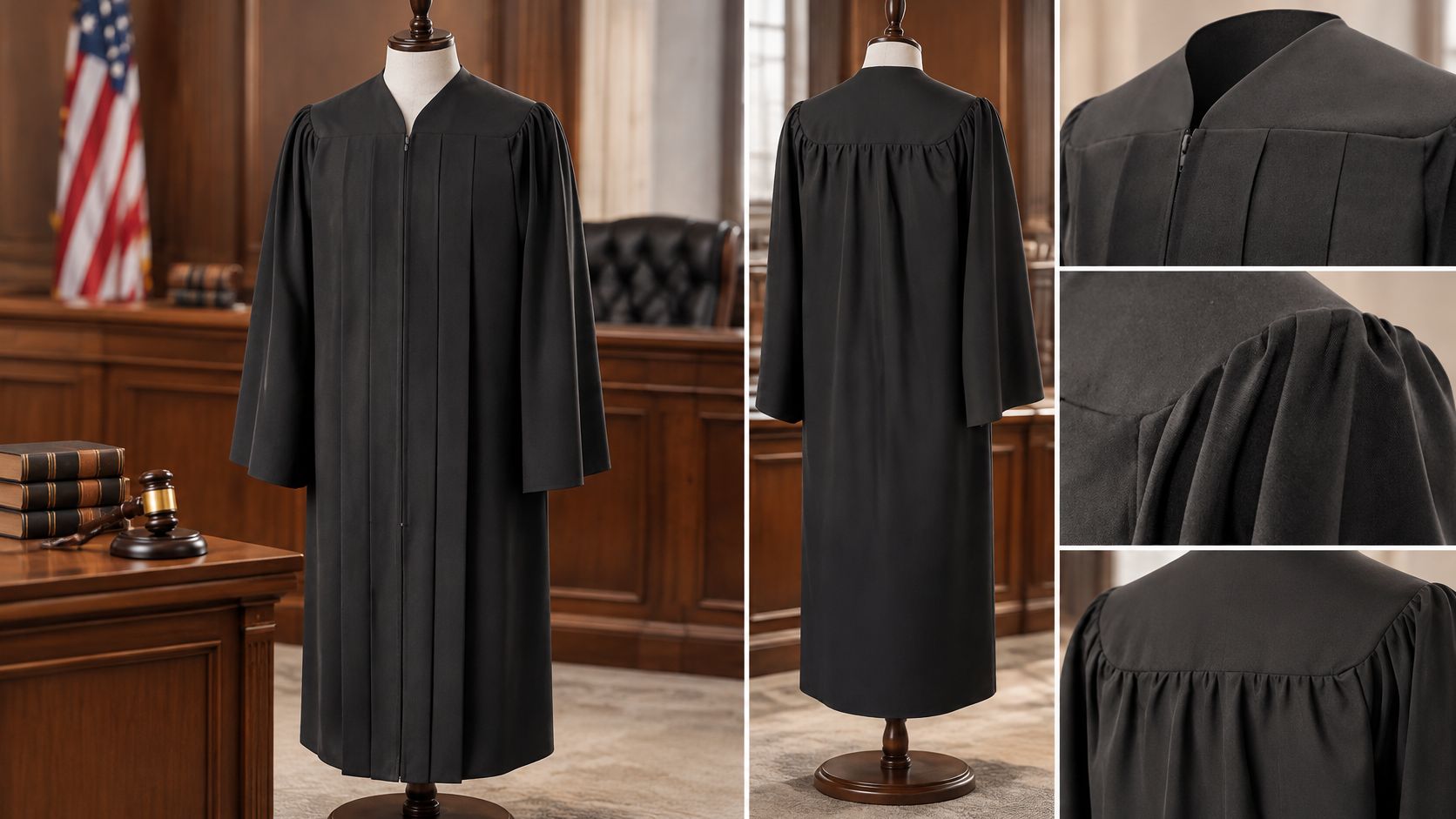
The following image shows a lightweight robe with traditional full sleeves and pressed pleats.
In-stock favors a simpler purchasing route
An in-stock robe may suit a near-term need when the listed option fits and is available. The Lightweight Judge Robe is designed with breathable fabric, while the Principal Judge Robe has traditional full sleeves and pressed pleats. Kenneth, a Judicial Attire customer, says: “We have used your Lightweight Judicial robes for the past two years with the light weight robes replacing our old heavy robes.”
Availability and fit still matter. Check that the chosen robe is available in the needed size before ordering.
Custom favors fit and construction choices
Judicial Attire offers customizable judge robes for women and men, and each robe can be customized to the customer's measurements. A custom option may be useful when a ready-made size does not suit the wearer's proportions or movement needs. For example, if a robe fits across the chest but pulls at the shoulders when reaching forward, a larger size may add unwanted volume elsewhere.
Choose a style that local rules permit, then weigh the practical trade-off: in-stock options are listed for purchase, while custom robes allow measurement-based fit. Price alone does not establish which robe suits the wearer or the court. Check the listed construction features and consider which details matter for the required appearance and daily use.
How to Get Measured for a Custom Robe
Good measurements describe the body and the intended garment separately. Use a flexible dressmaker's tape, a full-length mirror, and another person to help; trying to measure your own back usually changes your posture.
Wear the clothing you expect underneath the robe, including any regular layers. Empty bulky pockets, stand naturally, and keep the tape level without pulling it tight.
Take measurements in a repeatable order
- Start with the approved coverage. Write down the court's requirements before measuring the garment length or sleeves. Don't substitute a preferred fashion length for the coverage your assignment requires.
- Record overall height and intended wearing length. Measure height without changing your natural stance, then identify where the robe should finish in your usual courtroom shoes. Check the proposed hem while seated as well as standing, because a standing-only fitting can hide problems at the chair or knees.
- Measure shoulders and the fullest chest. Have your helper follow the maker's shoulder reference points and keep the chest tape horizontal. Record the actual body measurement rather than adding your own allowance; explain seated and reaching needs separately so the maker can build appropriate ease into the pattern.
- Measure sleeves with the arm slightly bent. Follow the maker's specified starting point and measure toward the wrist without straightening or shrugging the shoulder. A sleeve that appears correct with the arms hanging still may retract too far when the wearer handles papers.
- Check back and front lengths separately. Measure from the specified collar or shoulder reference to the intended hem, then inspect the front over ordinary clothing. Don't assume matching tape readings will produce a level-looking hem on every body shape.
- Record and verify the measurements. Enter the readings and units on our downloadable order form, noting any asymmetry or movement concern. If a field is unclear, contact our support team before submitting rather than guessing what the label means.
The visual guide summarizes the coverage checks and recording process.
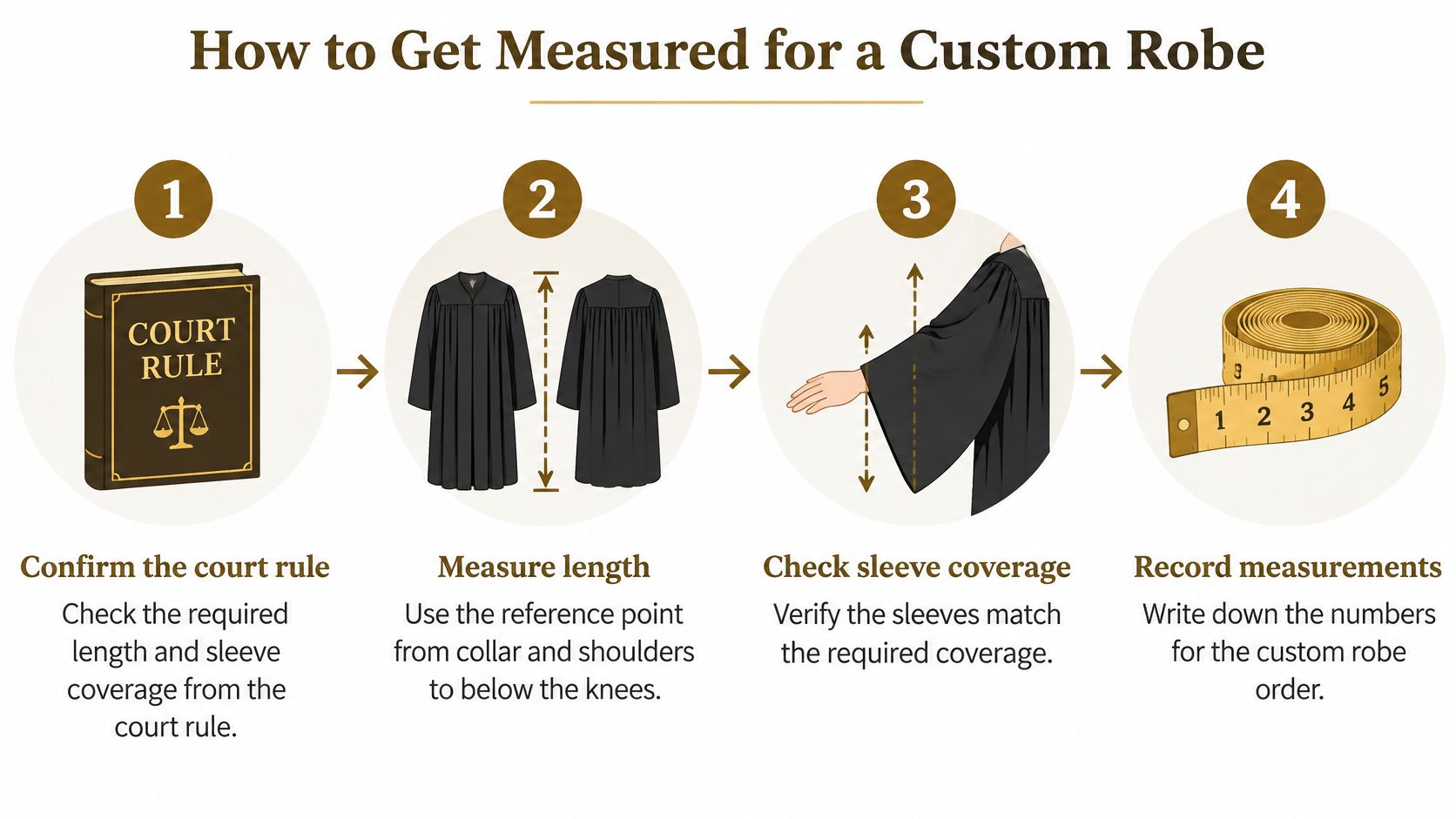
Use the maker's reference points
Robosize's guide to how to measure for men's clothing is useful for understanding basic body measurements and tape placement. Robe ordering still requires the garment maker's own reference points, especially for shoulders, sleeves, and finished length.
Use our measuring guidelines to complete the order. Before sending it, compare the intended finished dimensions with the court's requirements and resolve any measurement taken over a heavy coat or in an unnatural posture.
Fitting check: Send accurate body measurements and clear movement needs. Don't quietly enlarge every measurement to make the robe comfortable.
Customizing Without Losing the Uniform Look
A judicial robe should accommodate the wearer without drawing attention to the wearer's preferences. That's the central tension in customization: comfort requires individual adjustments, while courtroom dress usually depends on a consistent institutional appearance.
Judicature's analysis of judicial robes describes the black robe as a symbol of solemnity, impartiality, and uniformity rather than personal status or fashion. The practical consequence is straightforward: put customization into the pattern and construction before putting it on display.
Evaluate performance before ornament
A useful fitting isn't just a mirror check. Assess the robe under the movements and lighting it will encounter at work.
- Seated ease: The front shouldn't strain, spread, or bunch heavily when the wearer sits at the bench.
- Shoulder and sleeve movement: Reaching for a file shouldn't lift the whole garment or pull sharply across the upper back.
- Opacity: Check the black fabric over light-colored clothing under bright room lighting.
- Hem stability: The garment should hang evenly without twisting or catching beneath the chair.
- Restrained trim: Decorative elements should remain compatible with the court's established appearance.
Fullness has a trade-off. It can provide movement and the expected drape, but excess fabric may collect at the desk edge or interfere with armrests. Removing too much fullness creates the opposite problem: the robe starts behaving like a fitted coat rather than an outer judicial garment.
Rank changes by their visual impact
| Customization | Relative visual impact | Practical judgment |
|---|---|---|
| Length, sleeve, and shoulder adjustments | Lowest | Prioritize these when correcting fit |
| Lining, reinforced stitching, and concealed closures | Low | Choose for comfort, durability, and ease of dressing |
| Hand fluting, decorative braids, and prominent yokes | Moderate | Compare with the court's accepted silhouette |
| Visible embroidered initials | Highest among these options | Obtain approval before adding personal identification |
Location matters as much as the feature itself. A concealed closure can solve a dressing problem without changing the courtroom view; exposed hardware can make the same functional change conspicuous. Similarly, internal reinforcement supports the garment without adding visual detail.
A successful custom robe looks like the court's robe, properly fitted to its wearer, rather than a statement piece.
Before approving a change, ask whether someone looking across the courtroom would notice improved fit or personal decoration. If the alteration makes the garment distinctly identifiable as one person's, leave it out unless the court has expressly accepted it.
For administrators buying for several judges, establish an approved visual specification while allowing individual fit adjustments. Requiring identical body proportions isn't uniformity; maintaining the same institutional appearance is.
Wearability Needs Beyond Standard Sizing
A standard size chart can describe circumference and length without addressing how a judge dresses, moves, or manages discomfort. A robe may technically fit and still be difficult to fasten, too warm over required layers, or incompatible with a usual head covering.
Research on courtroom gender performance hosted by the University of Nebraska–Lincoln describes expectations that women judges remain especially poised, accountable, and emotionally restrained. Secure, comfortable clothing won't remove unequal scrutiny, but it can reduce avoidable distractions such as slipping closures or sleeves that require constant adjustment.
Match the modification to the problem
- Temperature changes: Fit over the layers the wearer uses. A lightweight robe option can be relevant, but fabric weight alone won't solve an overheated courtroom or excessive underlayers.
- Religious or cultural garments: Check neckline clearance, collar compatibility, and whether the robe catches on a head covering when dressing. Confirm permitted combinations with court administration.
- Limited dexterity or reach: Consider an accessible closure position, a discreet pull, or assistance-friendly fastening. Request a solution that doesn't create pressure against the body while seated.
- Mobility aids and seating: Check sleeves around wheels, controls, and armrests, and assess whether the hem catches during transfers or standing.
- Frequent wear: Inspect stress points at closures, shoulders, cuffs, and hems. Choose a care routine that follows the garment's instructions rather than assuming every black robe tolerates the same treatment.
Alter carefully and test in use
A hem adjustment can solve dragging, but cutting first is a poor approach. Pin or baste the proposed length, check it in courtroom shoes and the usual chair, and confirm that the finished coverage remains acceptable.
For an explanation of basic hemming technique, CleanOnline, North York's Premium Dry Cleaners, offers a step-by-step guide to sewing a hem. Its trouser-focused instructions provide background, not a robe-specific alteration pattern; a wide robe hem requires attention to drape and fabric behavior.
Accessibility priority: Solve the functional problem discreetly where possible, but don't sacrifice usability merely to avoid discussing an accommodation.
Test approved modifications through a full working day of sitting, standing, dressing, and handling documents. Customization alone doesn't create inclusion, especially for women judges, judges with disabilities, and judges whose cultural or religious dress isn't represented in standard patterns. Court approval and a workable garment both matter.
Choose Your Robe and Place the Order
A court-approved style, a clear fit specification, and a workable delivery date should all be settled before you submit an order. Keep those details together so the confirmation can be checked against what the court authorized.
The product listing helps you review the robe's configuration. Check the selected size, custom options, and any accessories, since a product photograph may not show every available selection. The screenshot below shows a custom product listing.
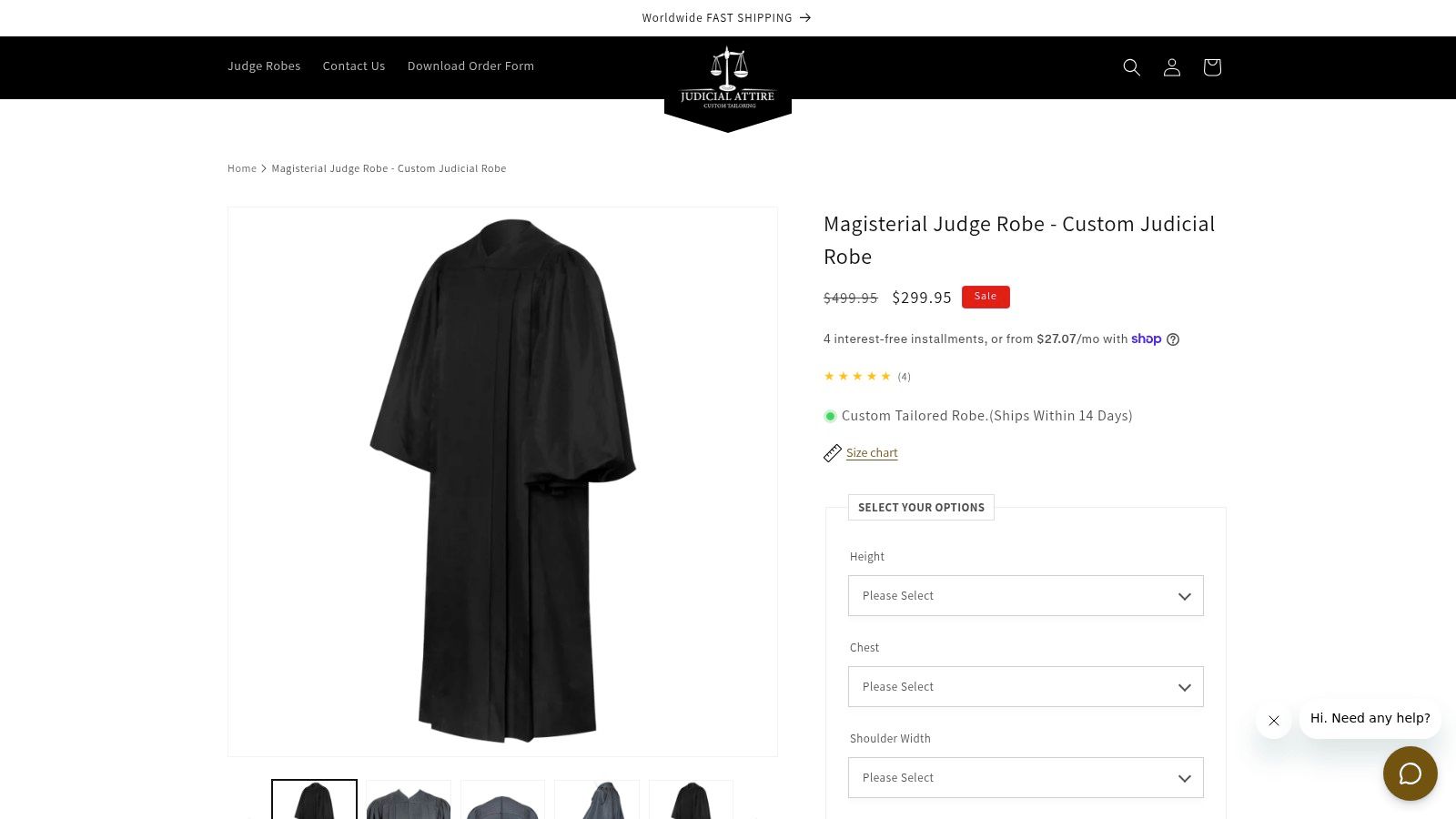
Build a complete order record
- Document court approval. Keep the applicable dress requirement and written permission for modifications with the purchase record. Record who approved the selected appearance.
- Confirm the purchasing category. Identify whether the robe is listed as in-stock or custom. If an in-stock garment needs alterations, ask how that affects dispatch rather than assuming it follows the usual fulfillment route.
- Attach the finished measurement record. Include the wearer's name, units, and any agreed construction instructions. Keep body measurements separate from requests about finished garment dimensions.
- Submit through a supported channel. Judicial Attire accepts orders online, by email, or by telephone, and provides a downloadable order form. Save the submitted details and compare them with the order confirmation.
- Set delivery expectations. Provide the required-by date, complete delivery address, and recipient's contact details. Review the shipping and handling information and confirm the destination timeline before scheduling the robe's first use.
Judicial Attire advertises worldwide shipping and provides customer service during weekday Pacific Time business hours. Confirm the delivery arrangements for your destination before setting a first-use date.
The video offers another view of the garment's presentation as you review your selection.
Separate production from delivery
For a custom order, ask when the measurements will be accepted, when production is expected to finish, and how shipment will be handled. Treat a requested deadline as provisional until it is confirmed.
When ordering several robes, keep each wearer's measurement sheet separate and use one shared, approved style description. This helps prevent a person's measurements or alteration instructions from being assigned to someone else.
On arrival, compare the robe with the order before its first scheduled use. Try it over courtroom clothing, check the closures, seams, and hem, and keep the packaging and confirmation while resolving any discrepancy.
Assemble the court approval and completed measurements, then order the configuration that meets both. A clear specification makes it easier to check the delivered robe against the approved style and fit.
Judicial Attire offers in-stock and custom judicial robes for women and men, along with measurement guidance and a garment bag. Visit Judicial Attire to review the available styles and prepare an order suited to your court's requirements and fit needs.