

What Is a Judges Robe Called? Names by Country
A judge's robe is most commonly called a judicial robe; judge's robe and judicial gown are the other everyday names. But if those names describe the same garment, why can't a judge order any robe bearing one of those labels?
The missing detail is jurisdiction, the legal system and court where the garment will be worn. A familiar name helps you identify the category, but it doesn't tell you whether the court requires a particular colour, sleeve length, neckline, or accessory. For judges and court administrators, the useful question isn't just “What is a judge's robe called?” It's “What does this court call it, and what must it look like?”
Table of Contents
- Common Names for a Judge's Robe
- Why England and Wales Call It a Judicial Gown
- Judicial Robe, Gown and Related Garments Compared
- How Jurisdiction Changes the Robe's Design
- How to Confirm the Right Name and Specification
- Choose the Name Your Court Uses Before You Buy
Common Names for a Judge's Robe
Judicial robe is the clearest general name for the garment. Judge's robe is the familiar everyday phrase, while judicial gown belongs to the same family of terms rather than identifying an entirely different item.
The wording you choose should match your audience. A reader looking for a simple definition needs less detail than a court administrator preparing a purchase specification.
| Name | Where It Is Most Used | What It Signals |
|---|---|---|
| Judicial robe | General and US usage; clearest term for products and searches | Formal court dress in general terms |
| Judge's robe | Everyday wording for the garment category | Plain, familiar language for buyers |
| Judicial gown | British legal and historical usage, as well as American usage | The garment's cut and professional tradition |
| Court robe | Descriptive references to courtroom clothing | The garment worn in court |
| Court dress | The regulated system of attire in England and Wales | The wider clothing requirements, not one garment |
American usage and the black robe
In the United States, judicial robe and judge's robe are the usual terms. The plain black garment is closely associated with the dignity and continuity of judicial office, but black wasn't the Supreme Court's only early choice.
According to the US Supreme Court's historical FAQ, the Justices first appeared in a regularized set of robes in February 1792, and those early robes are believed to have included red-and-white decoration before the adoption of all-black robes. That history helps separate the garment's name from its appearance: it was still a judicial robe when its decoration looked different.
For an American audience, there's usually no need to replace the straightforward word robe with a more elaborate expression. Nor should a supplier's use of gown automatically suggest that the item serves a different purpose.
Naming rule: Use judicial robe for a broad search or product category. Use judicial gown when British legal tradition or historical context makes that wording more appropriate.
Court dress needs particular care. It can describe the whole arrangement of official attire, so it isn't always a precise substitute for the garment itself.
Why England and Wales Call It a Judicial Gown
A British judicial gown makes more sense when you think of it as part of an inherited system of official dress, not as an isolated black garment. Its history begins with clothing worn at the royal court rather than an outfit created exclusively for judges.
The Judiciary of England and Wales' history places the substantially established High Court costume in Edward III's reign, from 1327 to 1377, records black gowns for the County Courts created in 1846, and dates the modern civil-dress reform to 1 October 2008.
From royal attendance to working court dress
The development is easier to follow as a sequence:
- Royal-court origins: The basic costume included a long robe, a full hood with a shoulder-covering cowl, and a mantle. These were elements of formal attendance at the royal court.
- Separation by judicial work: Scarlet became associated with criminal proceedings, while black silk gowns became associated with civil work.
- County Court dress: Judges in the newly created County Courts also wore black gowns, extending the association between dark gowns and judicial duties.
- Modern civil and family dress: Reforms introduced a new civil robe and simplified working attire. Judges hearing civil and family cases generally adopted the new gown without wigs.
This sequence explains why gown remains useful British terminology. It connects the working garment to a professional clothing tradition that includes more than its colour or length.
A modern product photograph can help you identify a robe's construction, but it shouldn't be treated as a guide to British court requirements.
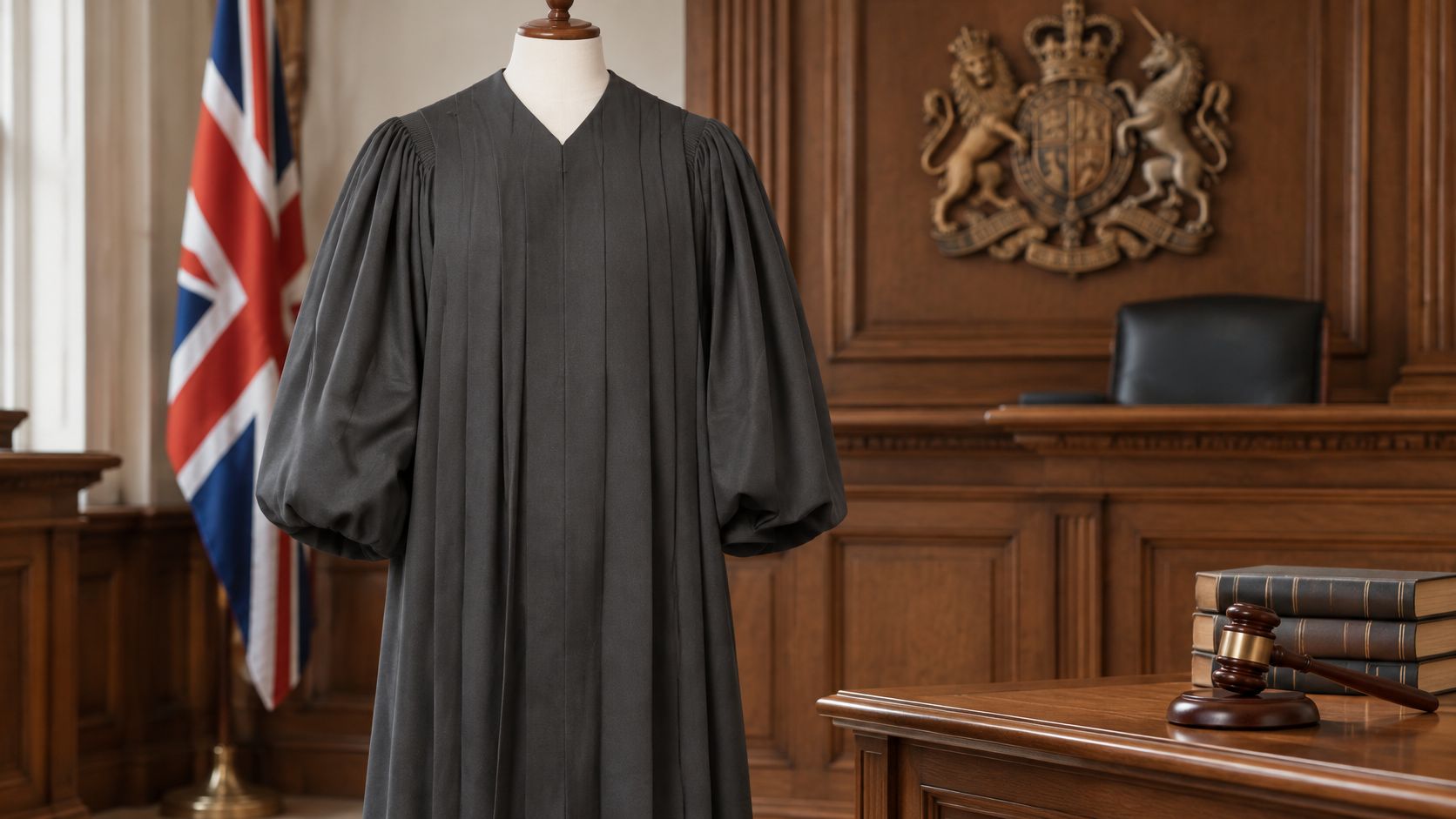
Suppose you're labelling a historical illustration of a judge wearing several layers. Calling the entire outfit a black robe could obscure the hood, mantle, and other components that matter to the description. Judicial gown identifies the principal garment; court dress provides the broader context.
Neither term means every judge in England and Wales wears the same outfit. Court level, judicial function, and ceremonial status remain important distinctions, even within a shared tradition.
Judicial Robe, Gown and Related Garments Compared
A barrister's gown, academic gown, mantle, hood, and tippet belong to related clothing traditions. Each one identifies a different role or a separate component of a fuller outfit, so none of them serves as an alternative name for a judge's robe.
Judicial robe, judge's robe, and judicial gown work as near-synonyms. Robe emphasizes official court use; gown draws attention to the garment's form and professional tradition. The jurisdiction decides which label fits: American usage favours robe, while courts in England and Wales apply gown to the same broad garment category.
The diagram separates those overlapping names from the surrounding terminology.
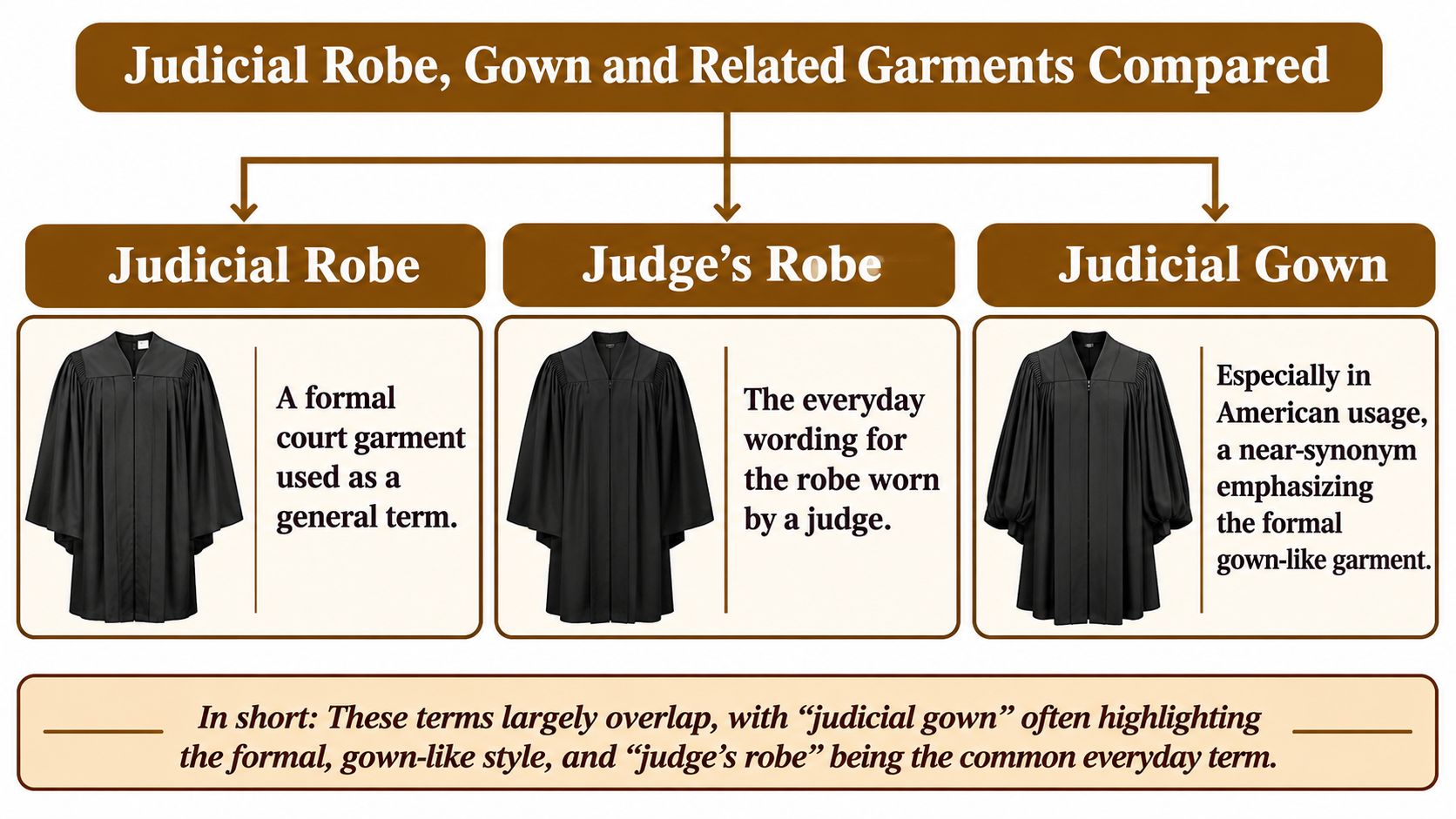
The garment and its neighbouring terms
The Encyclopedia.com account of legal and judicial costume describes the standard American form as a long black cloth or silk garment with bell-shaped sleeves and a yoked neckline, worn over ordinary clothing. The yoke is the shaped upper section from which the body of the robe hangs.
That construction separates the official outer garment from the wearer's personal clothing, and its uniform dark appearance supports the visual neutrality associated with judicial office.
| Garment | Role | Why Readers Confuse It With a Judicial Robe |
|---|---|---|
| Barrister's gown | Professional dress for an advocate | It's another formal gown worn in court |
| Academic gown | Dress associated with academic institutions and ceremonies | Its length and flowing sleeves can look similar |
| Mantle | A cloak-like outer component of formal dress | It can appear over a robe in a complete outfit |
| Hood | A separate historical or ceremonial component | It may be shown as part of the same ensemble |
| Tippet | A separate shoulder or neck-related dress component | Its position can make it look attached to the gown |
What matters is who wears the garment and in what capacity. A gown of similar cut can mark an advocate in one setting and a judge in another, so the correct label follows the role rather than the silhouette.
As you watch the video, look for the construction cues described above: the shaped yoke, the full sleeves, and the way the garment hangs over the wearer's own clothing.
One robe covers only part of what a judge wears in court. Questions about fit and layering lead to a separate practical topic: what judges wear under their judicial robes.
A judge's robe is judicial dress. A barrister's gown is advocate dress. Two garments can share a silhouette while marking entirely different professional roles.
How Jurisdiction Changes the Robe's Design
The name identifies a garment category, not a universal pattern. A court administrator can correctly request a judicial robe and still receive an unsuitable garment if the order leaves out the court's requirements.
Start by separating the features that a court may regulate from those a wearer might choose. Colour and accessories can identify judicial function, while construction details determine whether the garment meets the applicable rule and fits its intended use.
Elements to check before comparing robes
The Judiciary of England and Wales' court-dress examples show how dress changes with office and occasion, including gold neck tabs for some civil judges, red tabs for High Court judges, and scarlet robes for designated High Court ceremonial days.
| Element | How It Varies | Example |
|---|---|---|
| Colour | Set by court level, division, or ceremony | Scarlet for designated High Court ceremonial days; red commonly used for criminal work |
| Neck tabs | Distinguish judicial offices in modern civil dress | Gold for some civil judges; red for High Court judges |
| Wigs | Required or omitted according to the proceeding | Relevant civil and family proceedings generally without wigs |
| Materials and layers | Historical ensembles use different fabrics and separate garments | Silk, taffeta, fur, or miniver; mantle, hood, and girdle |
| Sleeves and neckline | Some rules prescribe features; others require further local confirmation | Check sleeve reach and the approved neckline |
| Ceremonial accessories | Form part of dress for particular occasions | Confirm the complete ensemble for designated High Court ceremonies |
The table shouldn't become a menu from which a purchaser freely mixes features. A neck tab, hood, or mantle belongs to a particular dress arrangement, not to a preferred style.
England and Wales
For relevant civil proceedings, the modern gown is worn without a wig and uses coloured neck tabs. Criminal work and ceremonial occasions can call for a different ensemble, so a photograph of a civil judge isn't a reliable specification for every judicial assignment.
Historical descriptions require similar care. A robe, mantle or cloak, hood, girdle, and neck bands describe separate parts of an outfit; silk, taffeta, fur, and miniver describe materials rather than interchangeable robe styles.
If you're preparing a request for a ceremonial appearance, identify the occasion before specifying the clothing. Otherwise, you may accurately describe an ordinary working gown while omitting the required ceremonial components.
The United States and California
American judicial dress is strongly associated with plain black robes, including those worn by Supreme Court Justices. That familiar appearance shouldn't be mistaken for a complete purchasing standard for every American court.
California provides a concrete example. California Rule of Court 10.505 calls the garment a judicial robe and requires black fabric, coverage below the knees, and sleeves reaching the wrists, with a style conforming to what is customarily worn in US courts.
The rule addresses colour, coverage, and sleeves without prescribing a particular material. You therefore can't infer a required silk fabric, lining, decorative braid, or closure merely from the words judicial robe.
Say an administrator compares two black robes. One product description emphasizes fabric and decoration, while the other provides detailed garment measurements. Neither description alone establishes compliance: the administrator needs the applicable requirements and enough construction information to check them.
Purchasing safeguard: Treat the court's requirements as the specification. Treat the product description as something to compare against it.
Turn the name into an orderable specification
A useful supplier brief records jurisdiction, court division, intended proceedings, sleeve and neckline design, colour, fabric weight, lining, and closures. It should also identify any required tabs, bands, hood, mantle, or other accessories.
Keep required features separate from personal preferences. Understanding why judges wear judicial robes provides context, but the governing rule or administrative policy should control the order.
How to Confirm the Right Name and Specification
Before writing a purchase request, gather the court's requirements and the wearer's measurements in the same document. That gives the person approving the purchase and the person making the garment a shared reference.
The checklist below summarizes the process from official terminology to a usable supplier brief.
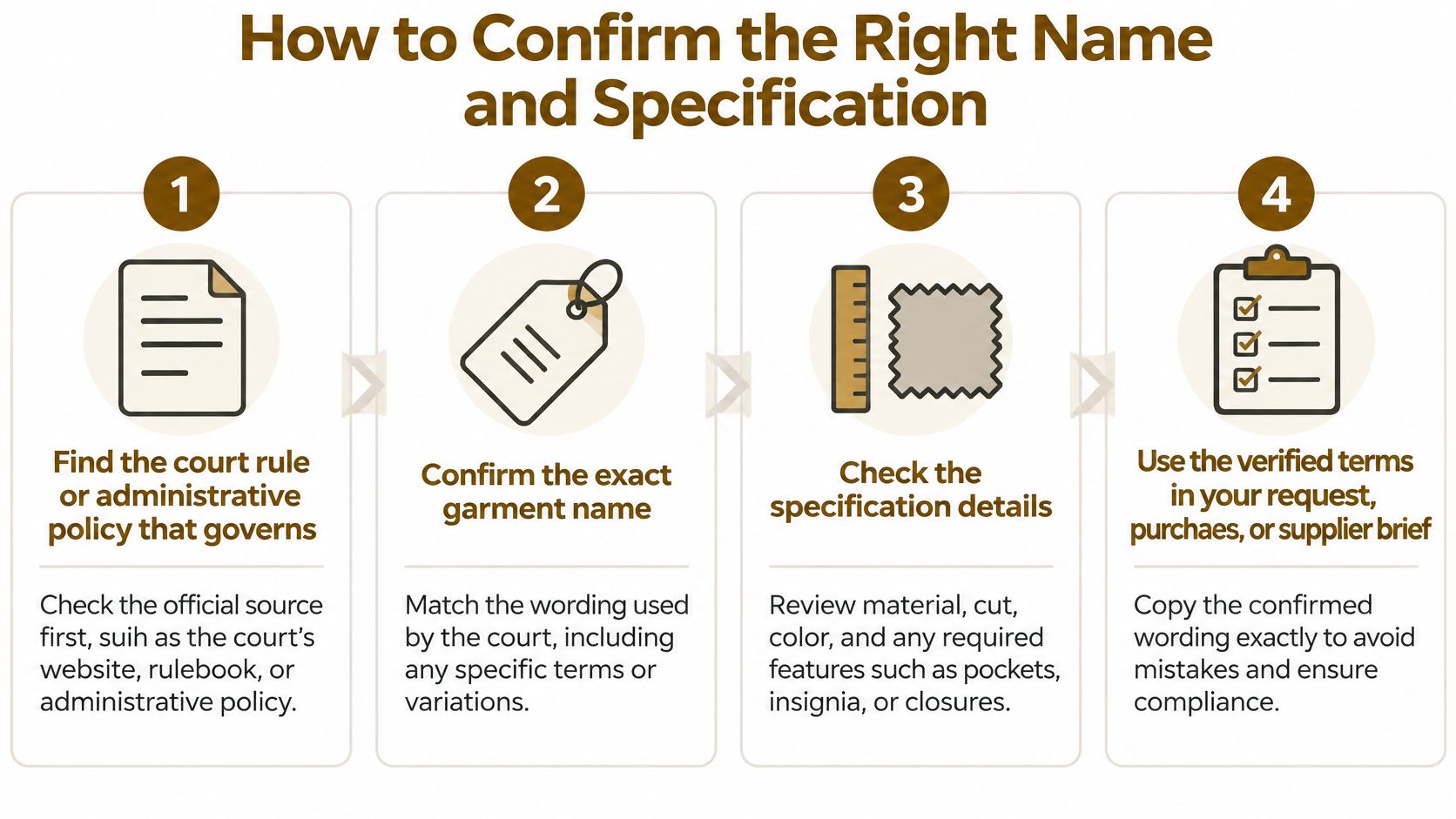
Build a clear request
- Find the governing court rule or administrative policy. Confirm that it applies to the wearer's court and duties. A common mistake is relying on a photograph from a different division.
- Copy the exact garment name. Use the court's wording in the request so approvers can connect it to the governing document. Don't replace court dress with robe if the policy addresses an entire ensemble.
- Record colour, length, and sleeve requirements. Translate each requirement into a feature that can be checked before purchase. Avoid ordering from a generic description that doesn't establish sleeve reach or garment coverage.
- Separate mandatory construction from optional styling. Note whether material, trim, lining, closures, and decoration are prescribed or left open. Silence in one rule isn't a reason to ignore a more specific local policy.
- List accessories and proceeding-specific requirements. Record tabs, bands, hood, mantle, and whether a wig applies. Don't assume that accessories shown in a photograph are included with the garment.
- Take the wearer's measurements using the ordering guidance. We can customize each judicial robe to the customer's measurements. Guessing from a usual jacket size can leave the supplier without the dimensions needed for the intended fit.
- Put the confirmed specification on the order. Include the approved term, required features, measurements, and any unresolved questions. Don't leave essential instructions scattered across separate messages.
Compare features without assuming approval
For example, the Juristic Judge Robe - Custom Judicial Robe has decorative shoulder braids, fully lined sleeves, hidden cuffs with buttons, and a draped yoke. Those are construction features to assess against the court's requirements, not evidence of universal approval.
Use the judge robe buying guide to organize purchasing questions once the governing requirements are clear. The strongest order is one a supplier can follow without guessing what the court intended.
Choose the Name Your Court Uses Before You Buy
The best term is the one that serves your immediate purpose. A definition, a historical caption, an online search, and an official order don't need identical wording.
Choose accordingly:
- For American readers: Use judicial robe or judge's robe when you mean the garment worn by a judge.
- For British or historical readers: Use judicial gown for the garment, or court dress when discussing the wider regulated ensemble.
- For online product searches: Combine judicial robe with the country or court name to narrow the results.
- For a court purchase: Use the term in the governing rule and attach the confirmed specification.
Let the official requirement settle the choice
A supplier may group garments under a broad category that differs from the wording in a court policy. That difference isn't necessarily a problem, but it requires a feature-by-feature comparison rather than an assumption based on the product title.
If the policy is unclear, resolve the uncertainty with the responsible court administrator before placing the order. In particular, distinguish an everyday working garment from attire required for a ceremony or a different judicial assignment.
Your next step is practical: check the applicable court rule, record its terminology, and prepare the specification before choosing a supplier. The common names are judicial robe, judge's robe, and judicial gown; the right purchasing term is the one your court uses.
Judicial Attire offers customizable judge robes for women and men in an array of styles. Once you've confirmed your court's terminology and requirements, visit Judicial Attire to compare the listed options and review measurement guidance for your order.