

Judge Robe Guide: Rules, Fit and How to Order
The usual advice is to buy a traditional black robe in your height and choose a fabric you like. That's the wrong order. A judicial robe is a working garment governed by courtroom requirements, not just a formal gown with a generous cut.
A useful judge robe guide starts with the court's rules, translates them into measurable specifications, and tests the garment on the person who'll wear it. Only then should you approve a standard size or a custom order. A robe that looks correct on a hanger can still pull across a jacket, catch against the bench, or become uncomfortable during a full calendar.
Table of Contents
- Court Rules That Set Your Robe Specifications
- Robe Styles Matched to Each Courtroom Setting
- Measurements to Take Before You Order
- How to Test Fit, Movement and Heat
- Accessories, Storage and Accessibility Needs
- Confirm Your In-Stock or Custom Order
Court Rules That Set Your Robe Specifications
Confirm the specific court's rules or administrative orders before choosing a size. Ask court administration for the applicable dress requirements, including any separate instructions for ceremonies. Record the document title and approval contact on the purchasing specification so the person ordering and the person accepting delivery use the same standard.
Use this lookup to identify what needs confirmation, not as a substitute for the court's current instructions.
Robe rules by court and setting
| Court or Setting | Color Rule | Coverage Rule |
|---|---|---|
| California courts | Black | Collar and shoulders to below the knee; sleeves to the wrist |
| U.S. Supreme Court and most federal and state courts | Black by established tradition; confirm local requirements | Obtain the court's prescribed or customary garment specification |
| Maryland highest court | Black for ordinary sittings; red for selected ceremonies | Confirm the current court dress instructions |
| England and Wales | Follow the dress prescribed for the case type and ceremonial setting | Confirm the robe and accessories prescribed for the judicial office |
California provides a useful worked example. California Rule of Court 10.505 specifies a black robe extending from the collar and shoulders to below the knees, with sleeves reaching the wrists, in the style customarily worn in United States courts.
Turn the rule into acceptance checks
Translate that language into checks a purchaser can perform:
- Coverage: Inspect the closed robe from the front and back. Confirm that the neckline, shoulders, and body remain covered without gaps.
- Sleeves: Check the sleeve endpoint on the wearer, rather than assuming a size label guarantees wrist coverage.
- Hem: Verify the finished length against the wearer's knees. Height alone doesn't establish where a particular pattern will fall.
Write pass or alteration required beside each check. A favorable price or attractive fabric doesn't compensate for a garment that misses the court's coverage standard.
Fit also requires more than circumference measurements. A review of clothing-comfort research hosted by the University of Rhode Island identifies objective measurements, wearer trials, and modeling as complementary methods, and explains that garment mechanics should accommodate movement and joint forces.
For purchasing purposes, document shoulder width, chest or bust, sleeve and back length, layering allowance, fabric construction, lining, and care restrictions. Then validate the specification through a wearer trial.
Purchasing rule: Separate the court's mandatory requirements from the wearer's preferences before requesting a quote.
For multi-court orders, black color, full coverage, and wrist-length sleeves are useful baseline fields, not universal legal requirements. Keep a separate column for each jurisdiction's additions, exceptions, and required accessories.
Robe Styles Matched to Each Courtroom Setting
Court rules determine the robe style. Start with the requirements for the specific court and sitting, then choose a garment suited to how it will be worn. Common options include a plain black robe, a scarlet or red traditional robe where authorized, and ceremonial robes with court-approved colored trim.
The Judiciary of England and Wales's history of judicial dress describes how robe colors, fabrics, and accessories have distinguished seasons, judicial functions, and formal occasions. A photograph may show ceremonial dress rather than what the court expects for everyday work, so confirm the applicable rules before choosing a style.
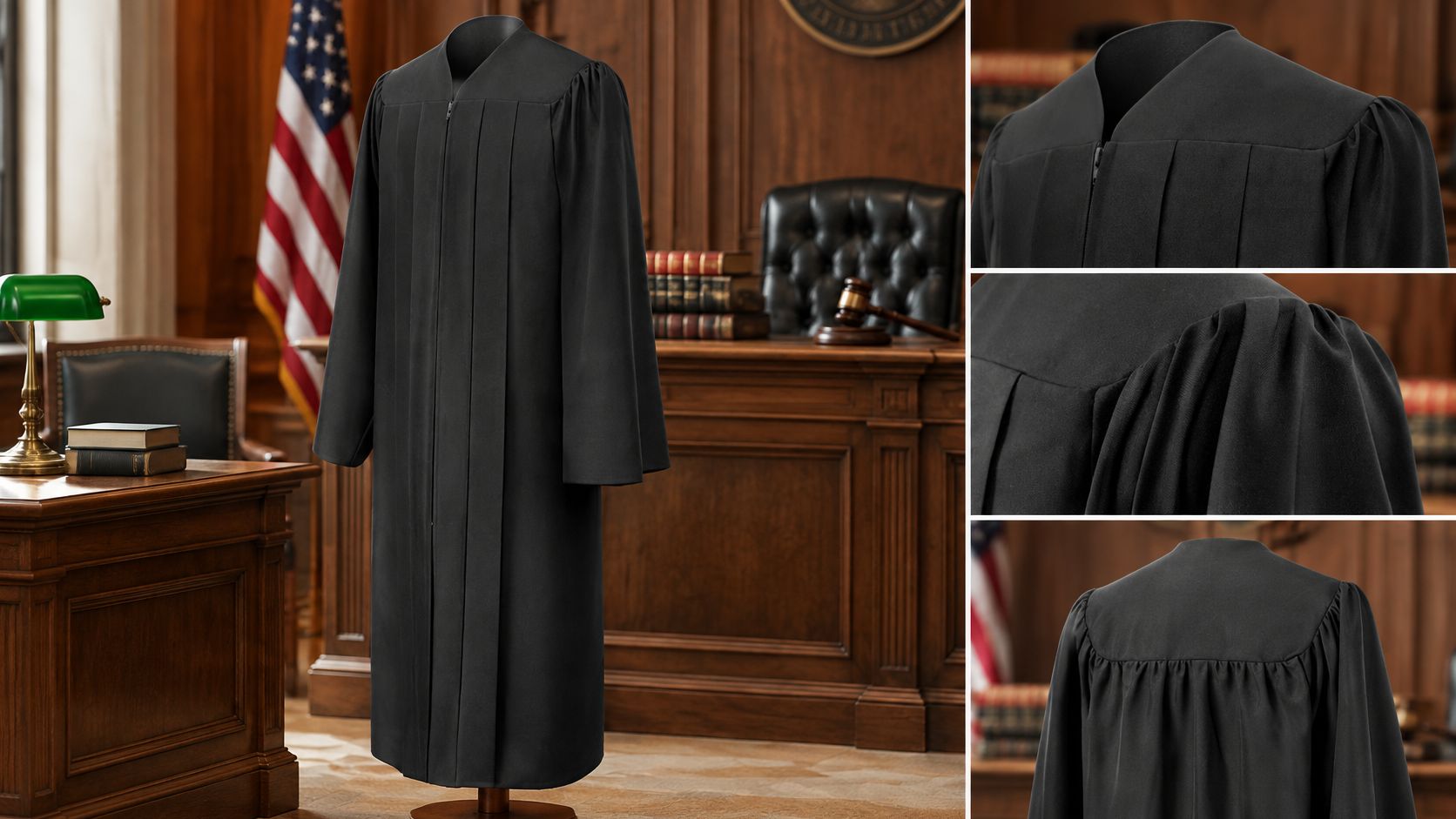
Robe characteristics by courtroom setting
| Courtroom Setting | Typical Use | Key Robe Characteristic |
|---|---|---|
| Ordinary hearings | Daily courtroom work over long sessions | Lightweight, breathable fabric that allows movement |
| Oral arguments and appellate sessions | Formal bench appearance | Full coverage and a well-structured cut |
| Ceremonial occasions | Investitures and special sittings | Ceremonial color or trim, where permitted by the court |
| Remote proceedings | Upper body visible on camera | Matte fabric and a neckline that sits cleanly on screen |
| Jurisdictions with prescribed colors | Court-specific rules | The required color and accessories |
Distinguish custom from obligation
Treat tradition as a starting point, then confirm mandatory requirements separately. Justice Sandra Day O'Connor's account of judicial robes in Smithsonian Magazine discusses the American black-robe tradition and the absence of a nationwide dress requirement.
For ordinary hearings, prioritize a garment that stays comfortable through long sessions without requiring frequent adjustment. For appellate sittings, consider how the front hangs while seated alongside colleagues. A structured appearance depends on a suitable cut, with enough room at the shoulders to move freely.
For remote proceedings, check the robe under the actual camera position and lighting. The neckline should sit evenly, and fabric highlights should not distract from the face. Camera framing is one consideration within the court's dress requirements.
When a court prescribes a color, collar, or accessory, follow that instruction over personal preference. Ask court administration to resolve uncertainty before approving decorative changes.
Measurements to Take Before You Order
Measure for the clothing that will sit underneath the robe. A close-fitting blouse and a structured suit jacket occupy different amounts of space, particularly across the shoulders and upper arms. Don't measure over one and assume the other will fit equally well.
Use a flexible dressmaker's tape and ask another person to take the back and shoulder measurements. Keep the tape level for circumferences and let it touch the clothing without compressing it. Record the units clearly, and distinguish body measurements from requested finished-garment dimensions.
Measurements, how to take them and what they must meet
| Measurement | How to Take It | Check Against |
|---|---|---|
| Standing height | Stand barefoot against a wall and measure crown to floor | Use for size selection, then verify the actual hem below the knee |
| Shoulder width | Measure across the back from shoulder point to shoulder point | Full shoulder coverage |
| Chest or bust | Measure around the fullest point over the clothing you'll wear | Room to breathe and move the arms |
| Sleeve length | Measure from shoulder point to wrist with the arm relaxed | Sleeve reaches the wrist |
| Back length | Measure from the base of the neck to the desired hem | Full front-and-back coverage |
| Hem position | Mark the intended finished hem on the wearer and record its position relative to the knee | Required coverage and safe walking clearance |
| Layering clearance | Record measurements over the suit jacket or blouse intended for court | Layers fit without pulling at the shoulders |
Record measurements without inventing allowances
Don't add an arbitrary amount of extra fabric to every measurement. A maker may already include wearing ease in the pattern. Adding your own allowance without explaining it can produce an oversized robe with dropped shoulders and cumbersome sleeves.
Follow our measuring guidelines, and identify which numbers describe the wearer and which describe the desired robe. If the maker uses a different sleeve-measurement starting point, retake that measurement using the specified method rather than trying to convert it from memory.
Standing height is a sizing reference, not a substitute for back length. Different torso and leg proportions can place the same nominal garment length differently on different wearers.
A complete measurement sheet is more useful than a familiar clothing size.
Keep all measurements on a single sheet, with the clothing worn during measurement noted beside the relevant entries. Add posture considerations, preferred hem position, and any asymmetry that may require individual attention. Use that sheet for the size comparison, fitting notes, and final approval rather than creating separate versions that can drift apart.
How to Test Fit, Movement and Heat
A robe's size label identifies a starting point for comparing garments. The practical test is how it fits and moves over the clothing worn in court. Try it on before accepting the fit, while alterations are still possible. For a custom order, agree on how the finished robe will be assessed.
Use the same sequence for each fitting so you can describe specific problems clearly.
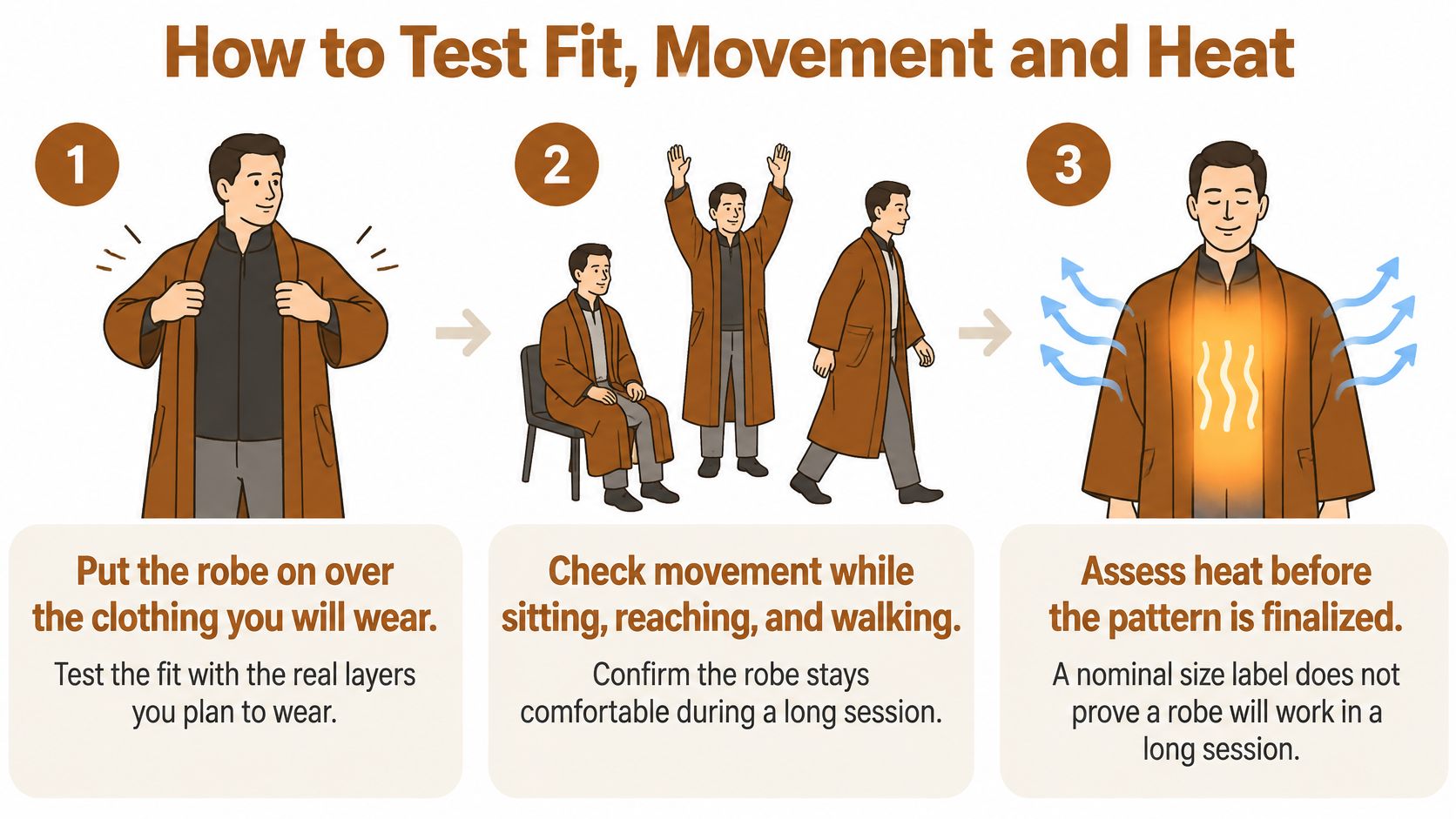
- Dress for the sitting. Put the robe over the clothing you intend to wear in court and fasten it as you would on the bench. The front edges should meet without being pulled into position.
- Sit naturally. Use a chair similar to the courtroom chair and remain seated long enough to assess pressure or pulling. Pay attention to the upper back, neckline, and fabric beneath your thighs.
- Stand and walk. Cross the room and turn at a normal pace. Note whether the hem catches your footwear, drags, or makes you adjust the sleeves.
- Reach for work materials. Reach forward and sideways as if retrieving a document or adjusting a microphone. Notice whether the robe lifts or the shoulders restrict your movement.
- Write and handle a binder. Rest your forearms on a desk, write a note, and lift a binder. Make sure cuffs leave your hands clear and sleeves do not sweep across papers or limit elbow movement.
- Assess warmth during seated work. Keep the robe on while doing desk work, and record the room conditions and clothing layers. That makes the comfort assessment relevant to the setting.
Choose construction after the trial
For a warm courtroom or substantial underlayers, consider a lighter construction. A more insulating garment may suit a cool room. Comfort also depends on lining, sleeve volume, air circulation, and how the robe feels when seated.
The Lightweight Judge Robe is an in-stock option made with breathable fabric for all-day courtroom comfort. Assess it over the intended court clothing and through the same movements you will make during a sitting.
Describe alteration needs as specific, observable problems, such as pulling across the upper back when reaching forward. That gives the maker a clearer basis for adjusting the fit.
Accessories, Storage and Accessibility Needs
A robe that travels between courtrooms needs a storage routine, not just a hook behind the door. Use a judge robe garment bag for transport, arranging the robe so the shoulders keep their shape and the sleeves are not tightly folded. Let a damp garment dry before putting it in closed storage.
At the destination, take the robe out early enough to inspect it before the sitting. Check the closure, hem, and detachable items, then hang it clear of the floor and furniture. Careful packing helps preserve its condition, but cannot remove creases already set into the fabric.
Keep the care routine practical
Check the care label before choosing a cleaning method. Lining, trim, and closures may need different handling from the main fabric, so follow the instructions for the garment as a whole.
Use a wide hanger that supports the shoulders without stretching the neckline. Empty the pockets and fasten the robe enough to keep it balanced. If pressing is permitted, test the method on a concealed area and protect the fabric from direct heat.
Keep authorized collars, bands, and other detachable accessories together in a separate pouch. Store pins and sharp fasteners away from the robe to prevent snags. Use the measurement sheet to confirm that the intended underlayers still allow the required fit.
Specify accommodations as functional requirements
The judicial-attire history published by the Eastern District of Tennessee places robes in the context of professional clothing. The working requirement remains straightforward: the wearer must be able to perform courtroom tasks in the garment.
Describe an accommodation by naming the task and the obstruction:
- Mobility aids: Check whether the hem or sleeves approach wheels, controls, handles, or other moving parts.
- Seated use: Evaluate front length, fabric accumulation, and access to closures in the wearer's normal seated position.
- Hand function: Confirm that the fastening can be operated without uncomfortable grip strength or awkward reaching.
- Changing body proportions: Discuss pregnancy, posture, and individual proportions before fixing the pattern.
- Temperature sensitivity: Record the conditions that cause discomfort and assess fabric, lining, and underlayers together.
- Bench equipment: Test microphone placement and document handling without trapping fabric or creating sleeve interference.
Accommodation priority: Specify what the wearer needs to do, not just where the robe needs more fabric.
Raise accommodation needs with court administration early. Ask who can approve a departure from the customary cut and whether the court has an established alteration process. A broader chest measurement alone may not address access, seated balance, or fastening problems.
Share only the details the purchaser and maker need to construct and approve the garment. Useful specifications describe function: a reachable closure, clearance around an aid, or a sleeve that leaves the hand free while preserving required coverage.
Confirm Your In-Stock or Custom Order
The choice is standard-size convenience versus greater control over fit and styling. An in-stock robe makes sense when the wearer's measurements align with the size chart and the standard design meets the court's requirements. Custom work is worth considering when a standard garment would need several coordinated alterations.
Don't assume that in-stock means immediate delivery or that custom means every requested detail is possible. Confirm the selected configuration, alteration scope, and delivery expectations before authorizing payment, particularly for an investiture or another fixed event.
In-stock and custom robes compared
| Criterion | In-Stock Robe | Custom Robe |
|---|---|---|
| Fit control | Closest standard size from a size chart | Made to the measurements and specifications accepted for the order |
| Styling | Standard design | Personal styling options selected at order |
| Timing | Ready to ship when the selected option is available; confirm dispatch | Production time required; confirm directly |
| Best when | You know your size and the standard design meets the court's rules | Measurements sit at the edge of standard sizes or specific features are required |
| Verify before ordering | Size chart against your measurement sheet | Measurements, design, and any pattern details approved in writing before production |
Resolve borderline measurements before paying
If one measurement sits at the edge of a standard size, don't automatically size up. A larger robe might solve chest clearance while creating excessive sleeve length or dropped shoulders. Compare the finished dimensions and determine whether a targeted alteration or custom pattern offers the cleaner solution.
For custom work, get written confirmation of what the maker will use: body measurements, finished sleeve and back lengths, layering allowance, and approved styling. Ask whether a pattern review or fitting stage is included rather than assuming it is.
A custom order still needs an acceptance check. Personalization doesn't remove the possibility of a measurement misunderstanding, so retain the approved specification and compare it with the delivered robe.
Run the final ordering checklist
- Confirm court approval: Save the current color, coverage, and accessory requirements in writing.
- Complete the measurement sheet: Include the intended clothing layers and any functional requirements.
- Approve the fit route: Compare standard dimensions with the sheet, or obtain written acceptance of the custom specifications.
- Document the trial: Record movement and temperature observations from a sample or fitting garment where available, then check the finished robe.
- Resolve accommodations: Confirm any necessary administrative approval before production or alteration.
- Plan handling: Choose transport protection, storage space, and a care method compatible with the garment label.
Send the order with one consolidated specification rather than scattered corrections across messages. Keep the final approval alongside the order confirmation, and confirm lead times directly with us before arranging a rush order.
Judicial Attire offers in-stock and custom judicial robes, including fitted options with personalized styling, and our team can help with measuring. Visit Judicial Attire with your court's requirements and completed measurement sheet to compare the appropriate ordering options and confirm timing before you purchase.