

Judicial Robes for Sale: How to Choose the Right Robe
You've got a hearing calendar, a robe that no longer fits comfortably, or a new judicial officer starting soon. Searching for judicial robes for sale brings up plenty of black gowns, but photographs won't tell you whether a robe meets the court's rules, stays comfortable through a long sitting, or becomes expensive to maintain.
Start with what the court accepts. Then choose the fit and fabric, and compare the cost per year of service rather than the purchase price alone.
Table of Contents
- Robe Styles at a Glance and Who Wears Each
- Check Your Court's Robing Rules First
- Accessibility and Accommodation Needs
- What to Measure for a Custom Robe
- Fabric Choices for Long Hearings and Travel
- Accessories Every Robing Room Needs
- Price Drivers and Total Cost of Ownership
- Confirm Your Measurements Before You Order
Robe Styles at a Glance and Who Wears Each
For most buyers, a plain black trial robe is the sensible starting point. Choose something different only when the court's dress requirements, the wearer's working conditions, or a specific fitting need justify it.
Before shortlisting, answer these questions:
- Where will it be worn? Identify the jurisdiction, court, and hearing types, including ceremonial duties.
- How much time will the wearer spend in it? Long daily sittings make weight, ventilation, and easy movement more important.
- Does the wearer need a standard or individual fit? Consider posture, underlayers, seated use, and access to mobility devices.
A judge sitting daily in a warm courtroom gains more from a light, comfortable robe than from unnecessary decoration. An appellate judge whose court expects fluting or braid needs the appropriate formal finish, even if a simpler gown would cost less.
Judicial robe styles compared
| Style | Typical setting | Key features | Main trade-off |
|---|---|---|---|
| Plain black trial robe | Trial courts and daily hearings | Full-length black gown, full sleeves, concealed front closure | Minimal decoration; acceptance still needs checking locally |
| Lightweight all-season robe | Warm courtrooms and long daily sittings | Lighter fabric, breathable construction, crease-resistant options | Less shoulder structure; assess the fabric's opacity |
| Formal robe with fluting or braid | Appellate and senior courts where expected | Shoulder or yoke fluting, pleated front and back, decorative detail | Higher cost and more careful upkeep |
| Custom tailored robe | Judges needing an individual fit or permitted personal styling | Cut to individual measurements, optional embroidered initials | Longer ordering process; alterations governed by order terms |
| Scarlet or trimmed ceremonial robe | Special occasions and courts whose custom calls for trim | Scarlet trim or tippet, formal finish | Appropriate only where court dress rules permit it |
| Civil gown style | Applicable civil courts in England and Wales | Gown design introduced through court dress reforms | Confirm the current requirements for the judicial role |
The Judiciary of England and Wales' history of judicial dress records that reforms introducing a new civil gown took effect on 1 October 2008. That institutional background matters: robe styles aren't interchangeable fashion choices.
Read the setting before the features
Treat a row whose setting doesn't match your court as a non-option. A scarlet finish isn't an upgrade for a court that requires plain black, and elaborate fluting doesn't make an uncomfortable robe more useful.
Style categories also overlap. A custom robe can be lightweight and plain, while a ready-made robe can include formal details. Separate the required appearance from the construction choices you can control.
Buying rule: Pay for features that satisfy the court or improve the wearer's working day, not for decoration that adds no practical value.
Check Your Court's Robing Rules First
The most formal robe isn't automatically the safest purchase. Extra trim, an unfamiliar cut, or ceremonial accessories can make an otherwise well-made gown inappropriate for ordinary hearings.
California Rule of Court 10.505 requires a judicial robe to be black, extend from the collar and shoulders to below the knees in front and back, have sleeves reaching the wrists, and conform to the style customarily worn in U.S. courts. A beautifully fitted robe that stops above the knee still fails that specification.
The rule doesn't prescribe a textile. That leaves room to choose materials for drape, durability, temperature control, and maintenance rather than assuming that a particular fiber is legally required.
Match the garment to the hearing
Rules can distinguish between proceedings, not just between courts. Nova Scotia's courtroom attire practice memorandum requires robes for appeals, judicial reviews, civil trials, and most criminal hearings, while allowing appropriate business attire for some chambers matters and other hearings.
Don't apply that rule outside its jurisdiction. Its practical lesson is to check the actual work the wearer will perform rather than relying on a general statement that a court is formal or informal.
Where there's no detailed specification, a conservative black robe with restrained styling is a sensible proposal to put to court administration. It isn't a substitute for approval.
Get a usable answer in writing
Ask the clerk, chief judge, or court administration to confirm:
- Applicable requirements: Obtain the current rule, practice direction, or approved dress specification.
- Hearing distinctions: Check trial, appellate, chambers, ceremonial, and remote appearances separately.
- Permitted details: Resolve questions about braid, fluting, collars, neck bands, and visible personalization.
- Approval responsibility: Identify who can authorize an exception or accommodation before ordering.
Save the response with the purchasing record. For a group order, attach the approved specification to the order sheet so the person measuring, the person authorizing payment, and the supplier are working from the same instructions.
Don't use a colleague's older robe as the sole template. It may reflect a previous requirement, a personal dispensation, or a fit that was never suitable for the next wearer.
Accessibility and Accommodation Needs
A standard cut shouldn't force the wearer to work around the garment. Establish functional needs privately with the wearer before choosing a size or approving a custom pattern.
Start with a seated movement check. For a wheelchair user, assess where fabric collects at the lap, whether sleeves catch on chair arms, and whether the hem approaches wheels or controls. Preserve the court's required appearance while resolving these issues through an approved cut or accommodation.
Record functions, not just a size
- Mobility and reach: Check clearance around walking aids, transfers, the bench, and a lectern. Test reaching forward without pulling the neckline backward.
- Closures and access: Consider grip strength, fastening position, and access to assistive technology or clothing pockets.
- Temperature sensitivity: Specify acceptable garment weight, lining coverage, and ventilation rather than requesting a comfortable robe.
- Religious requirements: Discuss head coverings, neckline coverage, and sleeve modesty before the design is finalized.
- Cleaning needs: Confirm that the complete garment, including lining and closures, tolerates the intended care routine.
Request any necessary court approval early. Don't assume the wearer must choose between access and compliance, and don't alter an approved uniform without checking the process.
Describe the movement the robe must allow. “Sleeve must clear the chair control during forward reach” is more useful than “needs extra room.”
Record approved features on the order sheet, with the wearer's consent. Keep sensitive medical information out of routine purchasing records; the supplier needs functional specifications, not an unnecessary diagnosis.
What to Measure for a Custom Robe
A robe can look correct on a hanger and still fail on the bench if the shoulder sits too far out, the sleeve covers the hand, or the hem pulls when the wearer turns from the lectern to the chair. Measure for the court's required silhouette first, then for movement. A compliant robe that has to be remade costs more than its ticket price once alterations, delay, and spare coverage are counted.
Use a flexible tape, a helper, and the clothing the judge wears in court. Keep the wearer standing naturally, feet together, arms relaxed. If the court requires a specific front closure, sleeve shape, or coverage level, record that requirement beside the measurements so the pattern choice and the numbers stay connected.
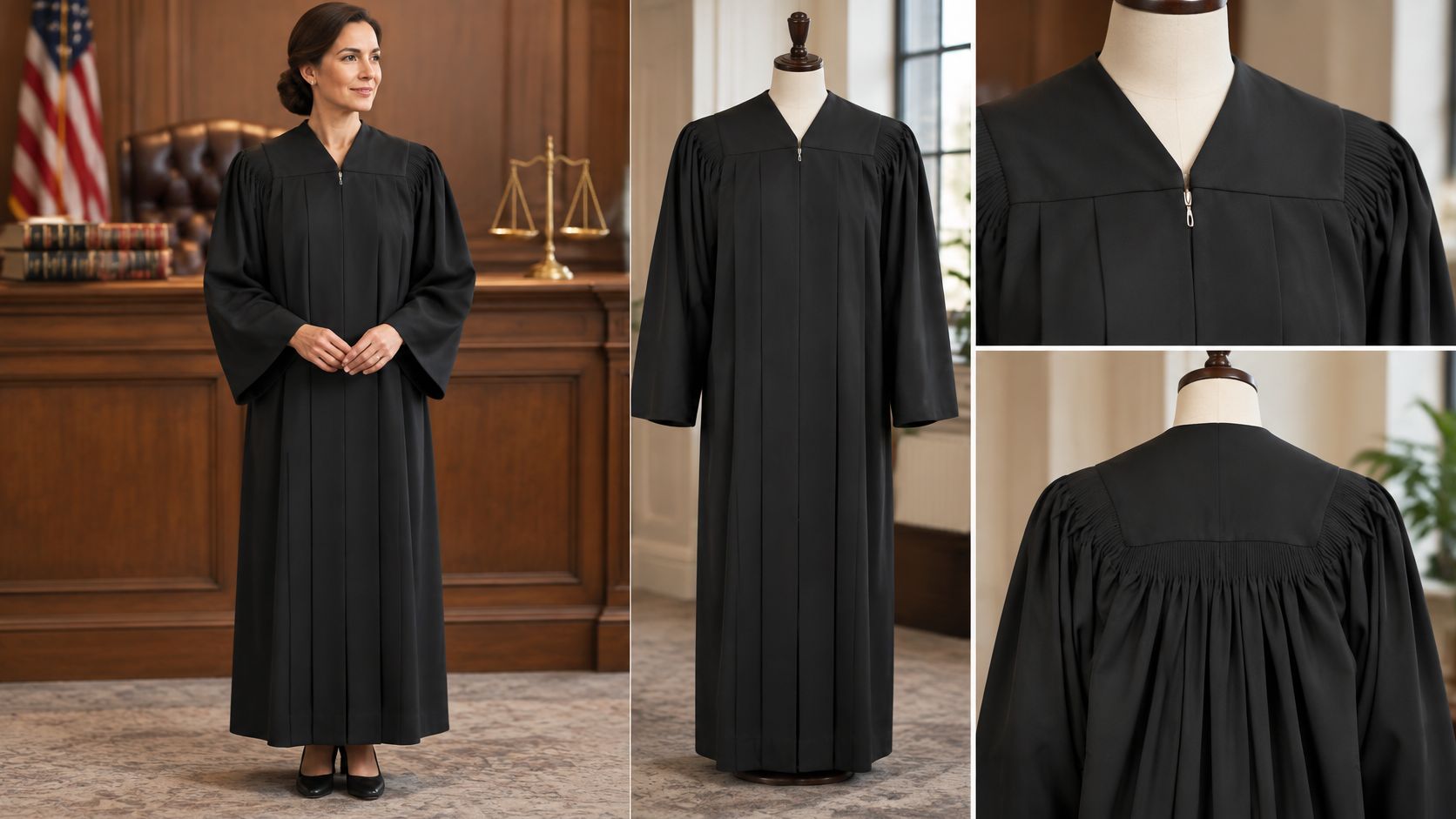
This example shows the relationship between shoulder detailing, sleeves, and the robe's front construction.
Measurements for a custom judicial robe
| Measurement | How to take it | Why it matters |
|---|---|---|
| Shoulder width | Across the back, shoulder point to shoulder point, arms relaxed; follow the supplier's seam reference | Sets where the robe sits on the shoulders |
| Sleeve length | From shoulder point to wrist with the arm slightly bent, unless the order form specifies another route | Establishes wrist coverage and prevents excessive cuff length |
| Chest | Around the fullest part, over the intended underlayer, with the tape level | Allows movement when sitting and gesturing |
| Waist | At the natural waistline, over the underlayer | Helps establish the gown's shape without restricting sitting |
| Height | Crown of head to floor, in shoes worn on the bench | Helps establish proportions; confirm finished robe length separately |
| Underlayer thickness | Record the actual blazer, blouse, shirt, or cardigan and measure over it | Prevents a tight fit after layering |
| Seating and mobility needs | Record seat height, device clearance, and relevant seated measurements | Guides functional fitting and accommodation details |
Give the pattern maker body measurements, not measurements inflated with guessed ease. Garment ease is the working room built into the finished robe; if you add it at the tape and the maker adds it again in the pattern, the robe can end up oversized at the shoulder and sleeve.
Use the supplier's measuring guidelines for a custom judicial robe to fix the measurement route before anyone starts. Two careful people can still produce different numbers if one measures to the wrist bone and the other measures to the shirt cuff.
Check the finished garment
The Plymouth Judge Robe - Custom Judicial Robe is a black custom judicial robe made for women and men. For any custom robe, ask which body measurements drive the shoulder, sleeve, chest, waist, and finished length before approving the order.
Compare the order sheet with proposed finished garment dimensions rather than relying on a size label. Confirm where length is measured from, whether sleeve length stops at the wrist or continues over a cuff, and how much ease is included at the chest for seated reach.
For a departmental order, keep one measurement sheet per officer with the date, method, shoes and underlayers used, approved adjustments, and final accepted dimensions. That record turns a later replacement into a reorder instead of a new fitting project, which matters when a court needs consistent appearance across several benches.
Fabric Choices for Long Hearings and Travel
A published textile comparison from Misciano reports wrinkle-recovery angles of approximately 130 degrees for polyester versus 45 degrees for linen under ISO 2313 conditions. That supports polyester as a travel-friendly starting point, but it doesn't establish how every finished robe will perform.
Wrinkle recovery describes how readily fabric releases a fold after creasing. Air permeability describes airflow through the textile; neither a fiber name nor a soft hand feel tells you the complete garment's ventilation performance.
Fabric options compared for daily courtroom use
| Fabric | Crease recovery | Heat and breathability | Care and upkeep | Best fit for |
|---|---|---|---|---|
| Polyester | Stronger than linen in the cited comparison; finished-fabric result still needed | Assess weave and lining; a close construction can feel warm | Some garments are washable and quick-drying; confirm the complete garment's label | Frequent travel and limited pressing |
| Polyester blend | Blend-specific performance unknown without testing | Fiber proportions, weave, and lining determine comfort | Confirm washing or cleaning requirements | Daily use where easy care and hand feel both matter |
| Wool | Product-specific recovery unknown | Insulating; evaluate fabric weight for the room | Often needs professional cleaning; follow the garment instructions | Cooler courtrooms and a structured drape |
| Linen | More prone to creasing in the cited comparison | Open, lightweight constructions can suit warm conditions | Expect pressing to maintain a smooth appearance | Hot conditions where visible creasing is acceptable |
| Cotton | Product-specific recovery unknown | Lightweight constructions can feel comfortable | Check shrinkage information and care instructions | Wearers prioritizing hand feel and suitable care options |
Judge the whole construction
A heavy lining can defeat the purpose of a lightweight outer fabric. Examine the yoke, sleeves, lining coverage, and ventilation together rather than buying by fiber alone.
Say a judge travels between sites and sits in a courtroom that remains warm despite air conditioning. A lightweight polyester blend is a reasonable candidate, subject to checking opacity, lining, and seated comfort. In a cold building, a wool robe may provide the desired warmth and drape if the wearer accepts its care requirements.
For anyone arranging sewing or alterations, Display Guru's guide to better garment fit with adjustable mannequins offers useful fitting context. A dress form can support drape checks, but it can't replace a seated fitting on the wearer.
When reviewing a lightweight courtroom option, request the actual fiber composition, care instructions, finished measurements, and any expected shrinkage allowance. Confirm return and alteration terms before approving custom work.
Fabric check: A travel-friendly robe must recover from packing, remain opaque under courtroom lighting, and feel comfortable after prolonged sitting. Test all of those conditions, not just the fabric's appearance on a hanger.
Accessories Every Robing Room Needs
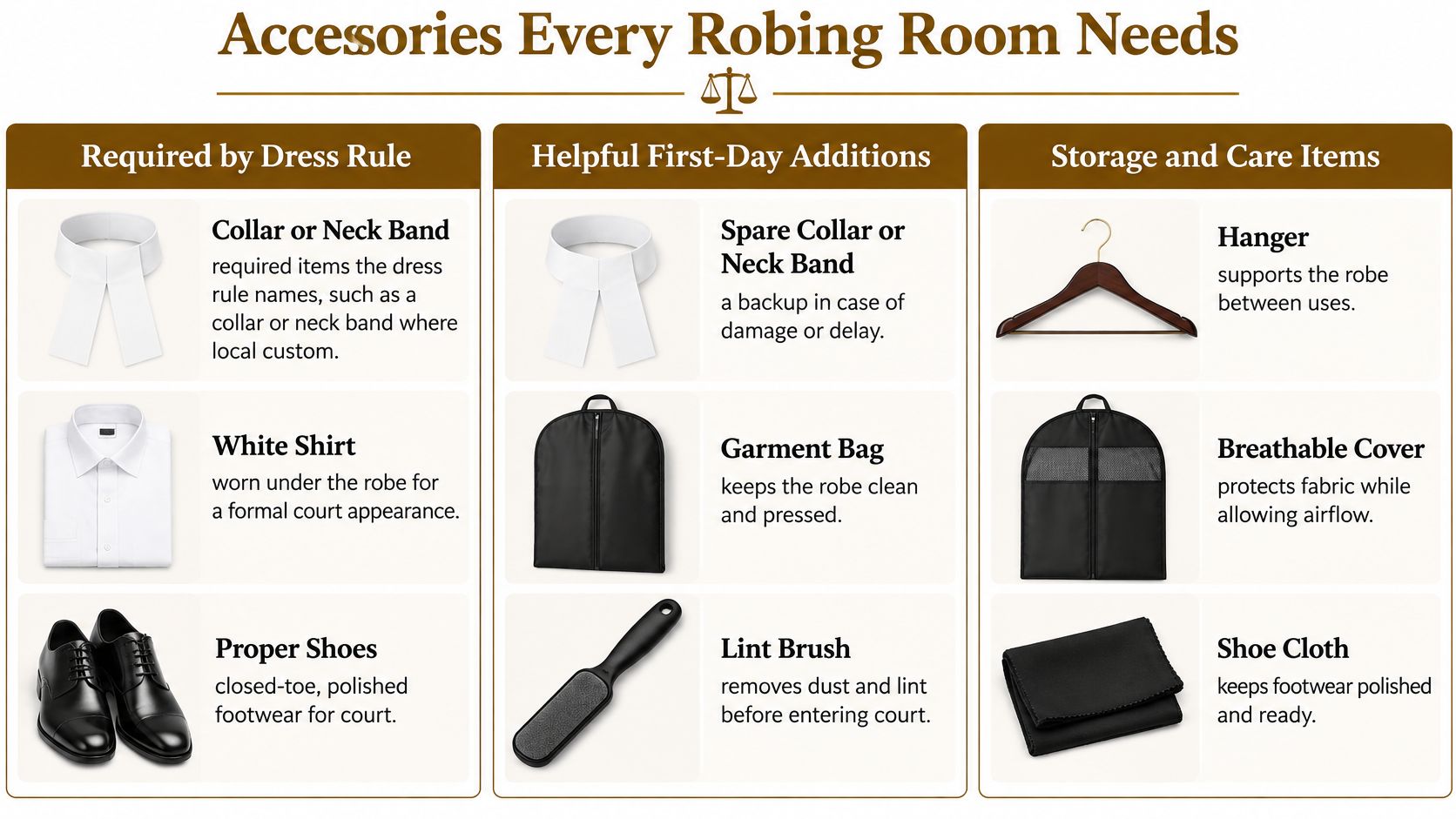
Buy required accessories before optional finishing touches. Keep a checklist beside the robe order so the wearer doesn't receive the gown without the items needed for the first hearing.
Use this visual as a room-preparation aid, with the court's actual dress rule taking priority over general clothing suggestions.
Required, optional, and protective
- Required by the court: Obtain a collar, neck band, or tippet only where the applicable dress requirements call for it. Confirm the specified form rather than buying a generic substitute.
- Optional additions: Settle the shirt, blouse, jacket, or cardigan before fitting. Identification labels or permitted embroidered initials can help distinguish garments in shared rooms.
- Protective equipment: Provide a shaped hanger, breathable storage cover, lint brush, and suitable storage and transport protection. Avoid crushing the shoulder detailing beneath other clothing.
- Care backup: Keep a steamer only if the garment's care instructions permit it. A spare robe can be useful when cleaning or repairs would otherwise leave the wearer without suitable attire.
Hang the robe after use and let moisture dissipate before enclosing it for storage. For transport, arrange the sleeves and panels without forcing sharp folds through decorative work.
For a visual supplement to robing-room preparation, the following video is available.
Buy what the dress rule requires first, then what protects the garment. Decorative additions can wait.
Price Drivers and Total Cost of Ownership
Price the decision as cost per year of service, not as a tag on a hanger. A $39.95 in-stock robe can be the right buy for a light calendar, while a $109.95 custom robe can cost less over time if it avoids early replacement; confirm the current quote before budgeting because prices can change without notice.
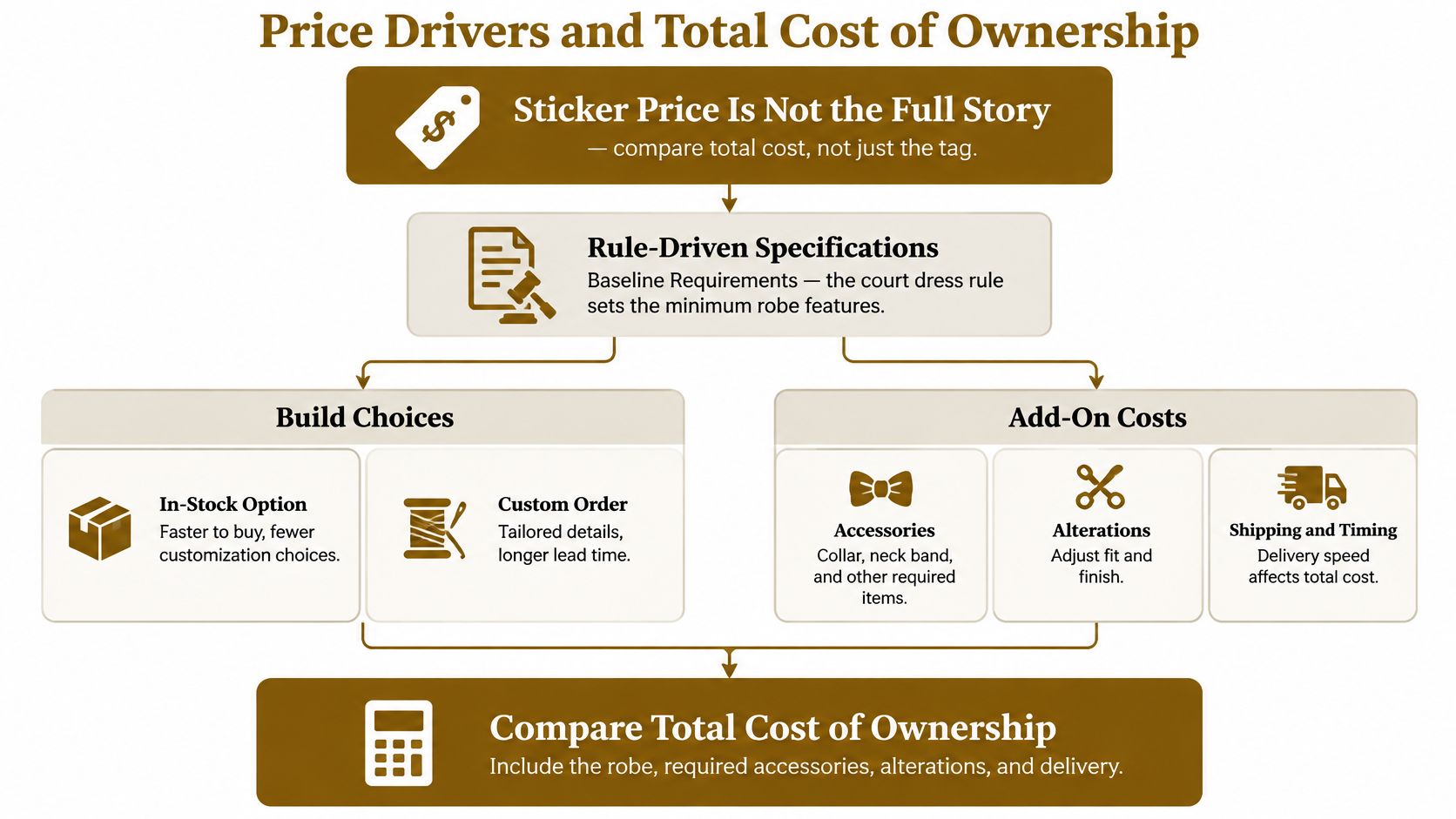
Compare costs in a consistent order
Start from the compliant baseline, then price only what adds service life or required function.
- Required specification: Establish the compliant baseline before comparing quotes.
- Construction: Separate ready-made and custom work, then compare lining, trim, fluting, closures, and personalization.
- Materials: Assess fabric weight and composition against the intended service conditions.
- Ownership costs: Include alterations, cleaning, repairs, delivery, and eventual replacement.
Accessibility belongs in that baseline and should be priced before any emergency reorder. The U.S. Access Board's accessible courthouse guidance addresses accessible approach, entry, and exit to judges' chambers, reinforcing the importance of planning for the wearer's working environment.
Calculate annual service cost
Annual service cost = purchase, initial alterations, required accessories, and delivery divided by expected service years, plus annual cleaning and repair costs.
Use supplier quotes and a realistic replacement expectation. A higher-priced robe can cost less annually if it remains serviceable longer without increasing maintenance costs.
Run the same arithmetic on two quotes before choosing fabric. If a $39.95 robe must be replaced every year, five years of purchases reach $199.75 before upkeep. If a $109.95 robe remains serviceable for that whole period, its purchase subtotal stays $109.95 before upkeep; cleaning, repairs, and alterations then decide whether the gap is real.
Ask what can be repaired, whether closures can be replaced, and how the garment should be cleaned. For institutional purchases, document composition, packaging, and shipping arrangements alongside the quote. Long service life, repairability, and a manageable cleaning routine usually matter more than a low initial price.
Confirm Your Measurements Before You Order
The most common ordering mistake is approving a robe from a size label alone. The same labeled size can sit differently from one maker to the next, and a robe built to a label still fails if the finished sleeve or chest comes up short. Bring the written dress requirements, the fitting record, and the garment specification together before payment.
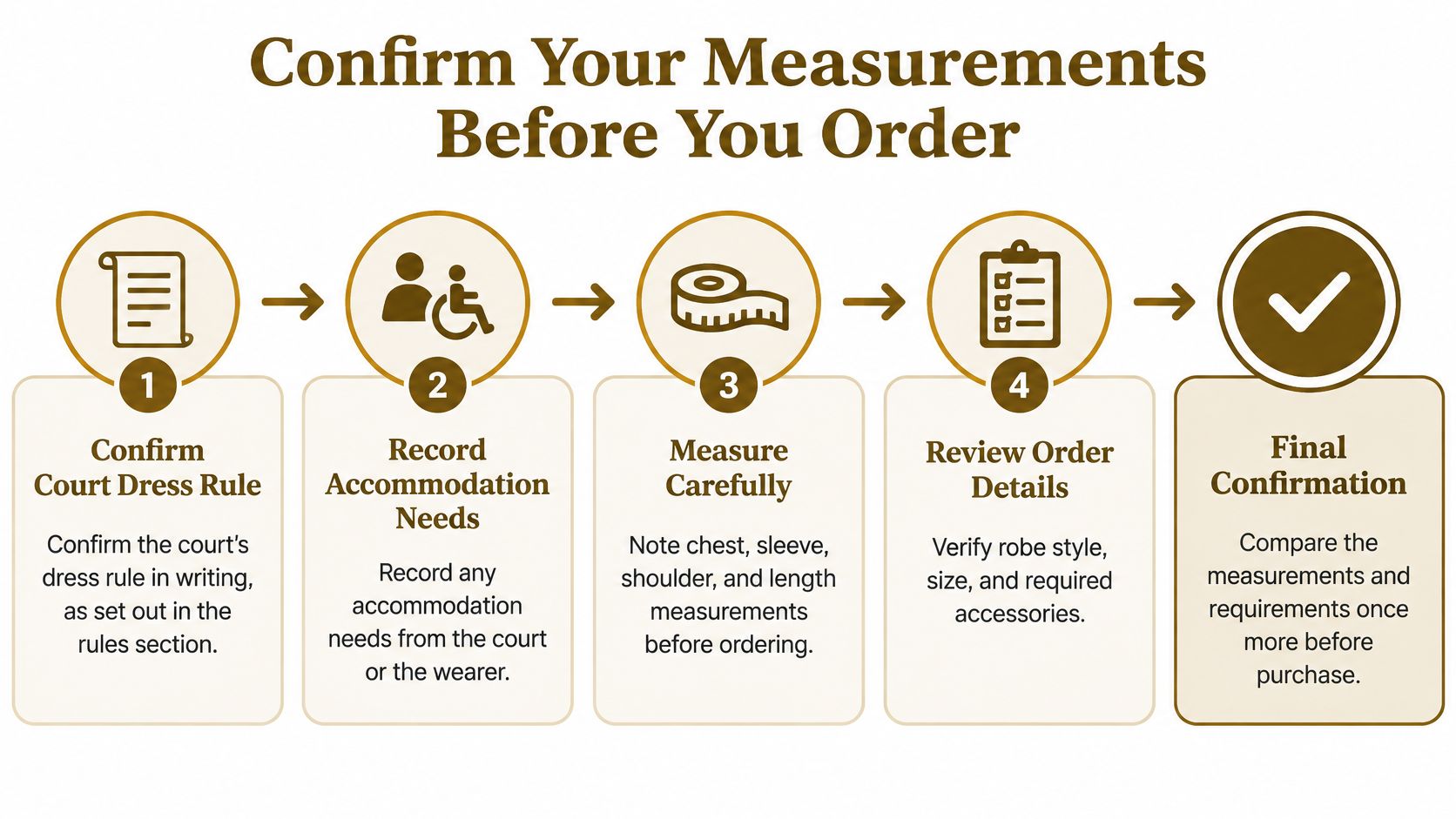
Approve the complete order
- Confirm authorization. File the written court approval of style and required accessories with the purchasing paperwork.
- Record accommodations. Functional adjustments identified earlier belong in the specification itself, not only in a conversation.
- Choose the ordering route. Decide between a standard ready-made fit and individually measured construction.
- Approve fabric and trim. Match the selected construction to the wearer's actual duties and room conditions.
- Confirm production and delivery. Obtain an order-specific timeline, including shipping and any fitting deadline.
- Review the terms. Check finished dimensions, alteration responsibility, returns, and the consequences of changing measurements after production starts.
- Submit the order. Judicial Attire accepts online, email, and telephone orders. For ordering assistance, call toll-free at 1-888-761-0956 or email hello@judicialattire.com.
- Inspect on arrival. Try the robe with the intended underlayers, then sit, stand, reach, and check closures before accepting the fit.
A measurement error caught at this stage costs nothing. The same error caught after production means paid alterations at best and a reorder at worst, which is why the fitting record deserves the same scrutiny as the quote. When translating a body measurement sheet into an ordering decision, ClothME's guide to compare measurements with brand size charts walks through the conversion. Keep body dimensions and finished garment dimensions clearly labeled on the same sheet so the maker cannot confuse the two.
Do not place the order until the court requirements, measurements, and fabric choice match. File the accepted fitting record with the department's apparel purchasing documents so the next replacement starts from the same verified numbers.
Judicial Attire offers judicial robes for women and men, including in-stock styles and robes customized to individual measurements, along with measuring guidance and garment bags. Visit Judicial Attire to review the options against your court's requirements and prepare an order based on fit, working conditions, and long-term service cost.